
What a 5 Dollar Deposit Actually Buys at an Irish Cashier
 Best casinos available in IrelandUpdated 7 November 2026



Nobody in Ireland pays in dollars, yet the phrase five dollar deposit online casino is typed here every week. It arrives with American and Canadian guides attached to it, and the cashier it lands on is denominated in euro. This page treats the dollar figure as what it is, a rough size signal of roughly a fiver, and then does the useful work: which payment rails actually let a sum that small through, what changes in the bonus column once you step up from the absolute minimum, and which of the costs around a small deposit are real rather than imagined.

 300 free spins Claim the bonus 18+ · Bonus terms in the WINSHARK rules
Short answerA no deposit bonus casino offer is bonus money or free spins credited after sign-up, before you pay anything in. You can win real money with it, but only after meeting the wagering, staying under the max bet, passing verification and accepting a cap on what you can withdraw. Our partner WINSHARK does not run a no deposit offer; its welcome deal is +250% on your deposit.
- Formats
- free cash, free spins, free chips, free play
- Between you and a payout
- wagering, max bet, max cashout
- ID check
- usually before the first withdrawal
- Age
- 18+ only
- GRAI online casino licences
- none issued yet (October 2026)
- WINSHARK welcome offer
- +250% on your deposit, a deposit bonus
Why an Irish search ends up asking for dollars

Search engines do not care which currency your bank holds. When a player in Dublin or Galway wants to know whether a casino will take a very small first payment, they borrow the phrasing that dominates the English-language internet, and most of that phrasing was written for the United States and Canada. The result is a query in dollars pointed at a market that settles in euro. The intent behind it is perfectly clear, and it has nothing to do with foreign exchange: the person wants to know whether the smallest realistic payment they can make will be accepted, and what it leaves them holding once it lands.
That matters because the dollar figure is not a product. No Irish-facing cashier has a button marked five dollars. What it has is a minimum deposit field, a list of methods, and a per-method floor underneath each of them. Translating the query honestly means answering a different question: at roughly five units of currency, what gets through and what bounces? The answer changes by rail, not by currency.
There is a second reason the dollar phrasing survives. Offers written for North America tend to be louder about tiny deposits, because the market there has spent years competing on that exact promise. Irish-facing sites compete differently, usually on payout speed and on the quality of the payment menu rather than on how little you can put in. So the expectations the query carries are frequently imported too, and some of them do not travel. The sections below separate the mechanics that are genuinely universal from the ones that belong to another market.
Finally, treat the number as a floor and not a plan. A deposit is the size of the hole you are willing to put money into, not a strategy. Everything useful about this rung comes from understanding what the cashier does with it, which is where we start.
The cashier converts before it validates
Here is the sequence that decides whether your payment goes through. You pick a method. The cashier looks up the minimum for that method, in its own account currency, which for an Irish-facing site is almost always euro. It compares your typed amount against that figure. Only then does your card, wallet or bank get involved, and only then does any currency conversion happen, if conversion is needed at all. In other words the validation is in euro and the conversion sits downstream of it.
The practical consequence is that a five-dollar intention becomes a five-euro action. You do not type a dollar figure and watch it convert; you type a euro figure, because that is the only field on the screen. If the rate of the day means that five euro is slightly more or slightly less than five dollars, nothing about the deposit changes. The method floor was never denominated in dollars in the first place.
Where conversion genuinely appears is at the funding instrument. If the card or wallet you fund from holds dollars, sterling or anything other than euro, somebody applies a rate and usually a margin on top of it. That is a cost of your own account setup, not a feature of the casino, and it is the one place on this page where a dollar-denominated balance really does change the arithmetic. We come back to it in detail further down, because the margin is often larger than players expect and it is charged on the way in and again on the way out.
One more detail worth internalising: the figure the cashier validates is the amount credited, not the amount you were charged. If a fee is taken at source by a wallet or a prepaid provider, the credited balance can land under the minimum and the deposit can be rejected even though money left your account. Always fund a hair above the floor rather than exactly on it.
Five euro versus the absolute minimum: what genuinely changes
Our one-euro deposit page exists because that rung is real and because it is almost entirely a payments story: at a single euro, the only question that matters is which rail will carry a sum that small without the overhead swallowing it. The five-euro rung is a different animal. It is the first step at which the bonus column stops being decorative.
Three things change as you move up. First, the set of methods widens considerably, because several rails have floors that sit above one euro but at or below five. Second, promotional qualification starts to come into play: a meaningful share of welcome offers set a minimum qualifying deposit, and the five-euro mark is the first point at which some of them are satisfied. Third, the balance is large enough to survive a handful of spins at a sane stake, which means the session stops being a novelty and starts being a short session.
What does not change is the back end. Verification requirements, withdrawal floors, dormancy rules and the limits you can set on yourself are identical whether you fund with one euro or five hundred. The only thing scaling down is your balance; the compliance machinery around it is fixed. That asymmetry is the single most important thing to understand about every small-deposit rung, and it is why the step from one euro to five buys more than five times as much usefulness.
If you want the euro-denominated treatment of this exact rung with the Irish method list in full, that lives on our five euro deposit guide. This page is deliberately narrower: it is about why the dollar framing appears, what the rung does to bonuses, and where the costs sit.
| Aspect | At the absolute minimum | At the five-euro rung | At the ten-euro rung |
|---|---|---|---|
| Method choice | Narrowest; several rails refuse the amount outright | Most common rails pass; a few prepaid and bank options still do not | Effectively the full menu |
| Bonus qualification | Rarely qualifies for a welcome match | First rung where some qualifying minimums are met | Qualifies for most structured offers |
| Spin headroom | A handful of spins at the game's minimum stake | A short session at a sensible stake | Room to pick games rather than take what fits |
| Withdrawal floor | Almost always above your whole balance | Often still above your balance unless you win | Frequently reachable |
| Verification load | Full KYC regardless | Full KYC regardless | Full KYC regardless |
| Fee drag | Proportionally brutal | Still material but survivable | Usually negligible in percentage terms |
Which rails let a five-euro deposit through

The floor on a deposit is set in two places and you only ever see one of them. The casino publishes a site-wide minimum; the payment provider enforces its own, and whichever is higher wins. This is why the same operator can accept a five-euro deposit by one method and refuse it by another on the same screen, with no explanation beyond a red field.
Card rails are generally permissive on the amount and strict on the authorisation. Fintech wallets are permissive on both and fast on the way back. Open banking and direct bank transfer are permissive in theory but surrounded by friction that makes a tiny deposit feel silly. Prepaid is the sharp edge: the denomination of the voucher you bought is a hard floor you cannot argue with. And crypto has no nominal floor at all but carries a network fee that can be a meaningful fraction of a sum this small.
The table below is about where each floor comes from rather than what it is. We do not quote figures, because they move by operator, by provider and by month, and a number on a page like this is a liability rather than a service. What does not move is the mechanism: once you know which party sets the floor, you know where to look it up for your own account in under a minute.
Our full comparison of the Irish menu sits in the payments section of the site; treat this section as the small-amount slice of it.
| Rail | Who sets the effective floor | Behaviour at a five-euro amount | Main friction |
|---|---|---|---|
| Debit card (Visa / Mastercard) | Casino's site minimum, occasionally the acquirer | Usually passes | Issuer gambling blocks and 3-D Secure step-ups |
| Fintech wallet (Revolut and similar) | Casino's site minimum | Usually passes | Merchant category blocks you may have switched on yourself |
| E-wallet (Skrill, Neteller, MuchBetter) | Wallet provider, then the casino | Often passes, sometimes excluded from bonuses | Bonus exclusion more than the amount |
| Open banking / pay by bank | Bank's own payment minimum, then the casino | Usually passes | Re-authentication for every single payment |
| SEPA bank transfer | Casino's minimum; banks rarely block small sums | Passes but is disproportionate | Settlement time and manual reference details |
| Prepaid voucher | The denomination you bought | Only if your PIN balance allows it | Leftover balance stranded on the PIN |
| Pay by phone bill | Carrier's billing increments | Depends entirely on the increment | Carrier billing is deposit-only |
| Crypto | Network fee, not a nominal minimum | Technically passes, economically questionable | Fee and price movement between send and credit |
Revolut and the Irish fintech habit

Ireland adopted app-based banking faster and harder than most of Europe, and the consequence for small deposits is that the most common funding instrument in the country is also one of the most permissive on amount. A fintech card or account will not usually object to a five-euro payment; what objects is the card control the user themselves enabled, or a merchant category block applied at the provider's end.
That distinction matters when a deposit fails. The error the cashier shows you is almost always generic, because the cashier is told declined and nothing more. The reason lives in your banking app, in the notification feed or the card controls screen, and it is far more often a category block than an amount problem. If a five-euro deposit is refused on a fintech card and the same card works elsewhere that day, check the gambling toggle before you blame the casino.
The second fintech-specific thing to know is the currency pocket. These apps hold multiple currencies, and if the account is set to pay from a dollar or sterling pocket while the cashier charges euro, your own provider does the conversion. Some do it at a clean rate during the week and a marked-up rate at weekends. On a sum this small the absolute cost is pennies, but as a percentage of a five-euro deposit it is not trivial, and the same spread applies again if the withdrawal comes back into a non-euro pocket.
Setup, limits and the withdrawal path are covered properly on our Revolut casino guide. For this page the point is narrower: at the five-euro rung, fintech is usually the path of least resistance in Ireland, and the failures you will hit are configuration failures rather than floor failures.
Open banking, SEPA and why a fiver feels absurd there
Pay-by-bank services push the payment through your own bank's authentication, which means a strong customer authentication step, an app approval and a redirect for every transaction. None of that scales with the amount. Approving a biometric prompt to move five euro takes exactly as long as approving one to move five hundred, and that asymmetry is why small deposits by open banking feel out of proportion even when they work perfectly.
They do generally work. Irish banks do not typically impose a payment minimum that would catch a five-euro transfer, so the binding constraint is the casino's own floor. The reason to prefer this rail at a small amount is not the deposit at all, it is what happens afterwards: a payment initiated from your bank account creates a verified link between your name and the account, which tends to smooth the first withdrawal. Paying in by bank once can save you a document request later. How that works in practice is on our pay by bank guide.
Plain SEPA transfer is different and worse at this size. You are typing an IBAN and a reference into your banking app, hoping the reference survives, and waiting for a settlement cycle. Instant SEPA has compressed the wait substantially, but the manual step remains, and a mistyped reference on a five-euro payment can cost more in support correspondence than the deposit is worth.
The rule of thumb: use open banking at this rung when you expect to withdraw and want the account link established early; avoid manual transfer at this rung entirely, and keep it for amounts where the overhead disappears into the size of the payment.
Debit cards: the amount passes, the authorisation might not
Cards are the default in Ireland and they are rarely the thing that rejects a small deposit on grounds of size. What rejects it is the chain of approvals behind the amount. A gambling transaction is flagged by its merchant category code, and Irish issuers treat that code with varying degrees of enthusiasm. Some decline it outright on credit products. Some allow it on debit but route it through an extra authentication step. Some let the customer switch it off and then forget they did.
There is also a mechanical quirk worth knowing. A card deposit is authorised first and captured second. In the window between the two, you may see a pending line on your statement that does not match your balance at the casino, and on a five-euro deposit that mismatch looks alarming out of proportion to the sum. Nothing has gone wrong; the authorisation has simply not settled. If it never settles, it drops off, and the money was never taken.
The more consequential card issue at this rung is the way refunds and withdrawals behave. Payouts to a card are usually possible but slower than to a wallet, and when they fail they fail quietly, landing you in a support queue. If you fund with five euro and win, the card you paid in with is frequently the only destination the operator will accept first, because of return-to-source rules. That is a withdrawal constraint created by your deposit choice, which is exactly the kind of thing people forget to think about when the deposit is small. Card timings and the return-to-source logic are set out on our Visa casino page.
Prepaid vouchers: the denomination is the floor
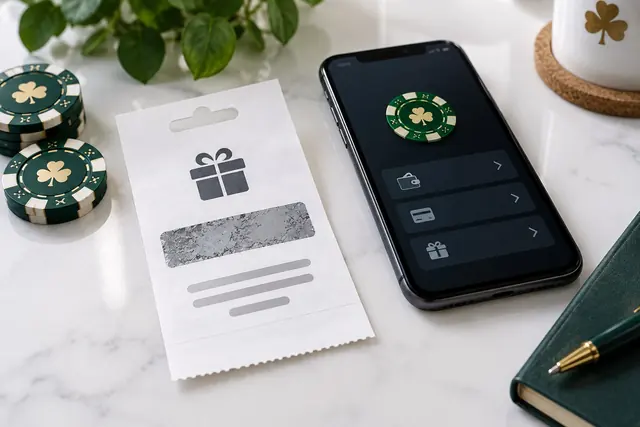
Prepaid is the one rail where the floor is genuinely outside everybody's control, including the casino's. You buy a voucher in a fixed denomination at a shop or online, and the PIN carries that value. If the smallest denomination sold near you is larger than the deposit you wanted to make, your effective minimum just became that denomination. You can deposit part of it, but the remainder sits on the PIN until you use it or lose track of it.
That stranded remainder is the real cost of prepaid at a small rung, and it is the reason we are lukewarm about it here. Topping up a casino balance with part of a voucher means you now own a payment instrument with an awkward balance on it, and prepaid PINs are easy to misplace and sometimes carry a maintenance deduction after a dormancy period. The deposit worked; the money management around it did not.
The second constraint is directional. Prepaid is overwhelmingly a deposit-only instrument, so a win has to leave by another route, which means registering a second method and verifying it. If you chose prepaid for privacy, that privacy evaporates at the first withdrawal. If you chose it to keep a hard ceiling on spending, it does that job well, and that is a legitimate reason to accept the drawbacks.
The mechanics, including what happens to a partially spent PIN, are on our prepaid casino guide. The summary for this rung: prepaid is a budgeting tool first and a payment rail second, and at five euro the budgeting benefit is mostly already handled by the size of the deposit itself.
Pay by phone bill at this size
Charging a deposit to a mobile bill is attractive at small amounts for an obvious reason: there is no card, no IBAN and no wallet registration, just a confirmation on your handset. The constraint is that carriers bill in increments of their own choosing, and those increments are not designed around casino deposits. If the smallest increment your carrier supports sits above the amount you wanted to pay, the rung is simply not available to you on that rail.
There is a cost question too. Carrier billing is a service the carrier is selling, and the economics of it are built into how the charge appears on your bill. On a five-euro deposit, any premium is proportionally significant, and it is one of the few places in the payment menu where the drag is structural rather than optional. On a larger deposit you might shrug at it; at this size it deserves a look at the terms before you confirm.
The hard limit is direction, again. You cannot be paid out to a phone bill. A carrier charge is a one-way street, so the moment you have a withdrawable balance you will be registering and verifying something else. For a player who genuinely only wants to play and has no expectation of withdrawing, that is irrelevant. For anyone else it means phone billing is a deposit convenience with a withdrawal bill attached, and the bill falls due at the worst possible moment, when you have just won something.
The full behaviour, including how the charge shows up for prepay versus bill-pay customers, is on our pay by phone casino page.
Crypto at a five-dollar equivalent: the fee is the floor

Crypto is the only rail on this page that is genuinely denominated in something other than euro, which makes it the one place where the dollar phrasing of the query has a kernel of truth. Stablecoins track the dollar, so a five-dollar stablecoin deposit is a real object. The problem is that the casino still credits you in euro at its own rate, and between your wallet and that credit sit two costs that do not scale down.
The first is the network fee. Sending a transaction costs what the network charges at that moment, regardless of the amount being sent. On a sum of this size, a congested network can take a fraction of the deposit that would be unthinkable on any other rail. Choosing a cheaper settlement network changes this dramatically, which is why the coin and the network matter more than the coin alone.
The second is price movement between send and credit. If you send a volatile coin rather than a stablecoin, the amount credited is the value at confirmation, not the value when you hit send. On a small deposit that volatility can push you under the casino's minimum, and a deposit that lands under the floor is a support ticket rather than a balance. Stablecoins remove this particular problem and leave only the fee.
Our view, set out at greater length on the Irish crypto casino page, is that crypto earns its place at larger amounts and on the withdrawal side, not at the five-euro rung. If you are funding this small, a fintech card does the same job with less to go wrong.
The conversion cost nobody budgets for
If every account in the chain holds euro, there is no conversion and this section does not apply to you. That is the position most Irish players are in, and it is the main reason the dollar framing of the query is harmless. But a growing number of people hold multi-currency accounts, and some genuinely do carry a dollar balance, so it is worth laying out where a margin can be applied.
There are up to three places. Your own provider can convert from the pocket you pay from into euro. The card scheme can convert if the merchant is processing in a different currency than your card. And a crypto or wallet route can apply its own house rate when crediting the casino balance. Each of these is a spread rather than a visible fee, which is precisely why it goes unnoticed: you do not see a line item, you see a slightly smaller number than you expected.
The important asymmetry is that the spread applies in both directions. Converting in to play and converting out to be paid means paying it twice on the same money. On a deposit of this size the absolute amounts are small enough to ignore, but the habit is not: a player who funds a dollar pocket, converts to euro to deposit and converts back on withdrawal is paying a toll on every cycle, and the cycles are where it accumulates.
The bar chart below is a deliberately hypothetical illustration of how the same nominal deposit can arrive as different credited balances depending on what sits in the chain. The numbers are invented for the purpose of showing the shape, not measured.
Euro account, euro cashierfull amount credited
Euro account, open bankingfull amount credited
Non-euro pocket, one conversionspread applied once
Non-euro card, scheme conversionspread plus scheme margin
Stablecoin, cheap networknetwork fee deducted
Stablecoin, congested networkfee is fixed, deposit is small
Illustrative figures only, chosen to show the shape of the problem. Real spreads and network fees vary by provider, by network and by the hour, and none of these values is a measurement.
The bonus column: what the five-euro rung unlocks

This is where the five-euro rung earns its keep, and where it differs most sharply from the absolute minimum. Welcome offers are built around a minimum qualifying deposit, and that figure is independent of the cashier's minimum deposit. A site can happily accept a one-euro payment and still require considerably more before a match applies. Five euro is the first rung at which some offers start to engage, and the first rung at which it is worth reading the promotional terms at all.
The mechanics to check are always the same three. First, the qualifying minimum: the smallest deposit that triggers the offer. Second, the match percentage and its cap, which together tell you what the deposit is worth in bonus terms. Third, the wagering requirement and what it is calculated on, because a requirement on bonus alone and a requirement on deposit plus bonus are different products wearing the same label.
At a small deposit, the percentage is the least interesting of the three. A generous match on a small deposit produces a small bonus, and a small bonus with a heavy wagering requirement produces a long obligation attached to a short bankroll. That combination is the classic small-deposit trap: the offer looks like free value and behaves like a lock on your own money, because the wagering has to be cleared before anything can leave.
The taxonomy of offers, and which ones are worth engaging with at all, is on our casino bonus guide. What follows here is the arithmetic of those terms specifically at this rung.
Why many welcome offers skip this rung entirely
Operators set a qualifying minimum for a reason that has nothing to do with generosity. A bonus has a cost to issue: the credit itself, the processing, the compliance overhead on a funded account, and the support load that comes with it. Below a certain deposit size that cost exceeds any plausible return, so the offer is gated above it. The gate is a business decision, and it is perfectly visible in the terms if you look.
Which means a site can be simultaneously honest about accepting tiny deposits and uninterested in bonusing them. Those two facts coexist constantly and confuse players who read the deposit minimum as a promise about the promotion. They are separate numbers in separate documents. The cashier minimum is in the payments table; the qualifying minimum is in the bonus terms, usually in the first or second clause.
There is a second gate that catches small depositors specifically: excluded methods. A meaningful number of offers exclude certain e-wallets and prepaid instruments from qualifying, regardless of the amount. If the rail that let your five euro through is on the excluded list, you have made a qualifying-size deposit by a non-qualifying method and the offer will not attach. The cashier will not warn you, because from its point of view nothing went wrong.
The practical sequence, then, is backwards from what most people do. Read the bonus terms first. Note the qualifying minimum and the excluded methods. Only then choose the rail and type the amount. Doing it in the other order is how people end up with a funded account and no offer, and no way to undo the deposit.
Free spins attached to a small deposit

Spin packages are the most common thing offered around small deposits, because they are cheap to issue and easy to understand. The number of spins is the headline and it is the least informative part. What determines the value of a spin package is the per-spin stake value, which the operator sets and which is usually at or near the game's minimum, and the game it is locked to.
The arithmetic is simple once you know those two things. A package's notional turnover is the spin count multiplied by the per-spin value, and anything the spins win is subject to whatever conditions the terms attach. There are usually two conditions and they do different jobs. A wagering requirement on spin winnings makes you turn the winnings over before they convert. A winnings cap truncates the result regardless of how well the spins went. A package can be wager-free and still capped, which is the shape that looks best and reads worst.
At this rung, a spin package is frequently worth more than a percentage match, because spins carry their own stake. Your five euro stays intact while the spins are played from the operator's side of the ledger, and if the terms are wager-free the result is a genuinely clean addition. That is the one configuration at the small-deposit end that we think is reliably worth taking.
Spin value, caps and the difference between the honest and the decorative versions of these offers are unpacked on our free spins guide, which is worth reading before you accept a package rather than after.
Wagering arithmetic on a small bankroll
Wagering is the mechanism that turns a bonus into an obligation, and it is calculated as a multiple of a base. The base is the variable that matters: a multiple of the bonus alone is one product, a multiple of the deposit plus the bonus is roughly double the work for the same headline figure, and a multiple applied to spin winnings is a third thing again. A player who reads only the multiplier and not the base has read half the term.
Let us do this hypothetically, with invented figures clearly labelled as such. Suppose a bonus of twenty euro with a thirty-times requirement calculated on the bonus alone. The turnover obligation is six hundred euro of stakes. Now suppose the same thirty-times is calculated on deposit plus bonus, on a five-euro deposit: the obligation becomes seven hundred and fifty euro. Same multiplier, same bonus, a quarter more work, and nothing on the promotional banner told you which version you had.
Against a small balance, turnover obligations of that order are not cleared by skill. They are cleared, if at all, by volume at low stakes, and the house edge is applied to every one of those stakes. That is the honest description of the mechanism: wagering is a requirement to expose your balance to the edge repeatedly, and the expected outcome of repeated exposure is loss. Some players clear requirements; the structure does not expect most of them to.
If you want a bonus without that mechanism attached, the wager-free category exists and is small. Our no wagering comparison covers what you give up in headline size to get there, which is usually a lot, and why it can still be the better trade on a small deposit.
| Bonus shape (hypothetical) | Base the multiplier applies to | Illustrative multiplier | Resulting turnover |
|---|---|---|---|
| 20 euro bonus credit | Bonus only | 30x | 600 euro of stakes |
| 20 euro bonus credit | Deposit plus bonus | 30x | 750 euro of stakes |
| 5 euro bonus credit | Bonus only | 40x | 200 euro of stakes |
| Spin winnings of 10 euro | Winnings only | 20x | 200 euro of stakes |
| Wager-free spin package | No base | None | Winnings convert directly, subject to any cap |
Session arithmetic: what a five-euro balance actually plays

A balance is only as long as your stake is small. That sentence is the whole of small-deposit strategy, and it is worth converting into numbers, hypothetically, so the shape is visible. Take a five-euro balance. At a stake of ten cent a spin it covers fifty spins before variance is counted; at twenty cent, twenty-five; at fifty cent, ten. These are arithmetic facts about division, not predictions about outcomes, and they are the only reliable thing anyone can tell you about a session this size.
What variance does to that count is a separate matter. Low-volatility games return small amounts frequently, which extends the spin count beyond the pure division because some spins are partially refunded. High-volatility games do the opposite: long dry stretches punctuated by occasional larger returns. On a balance of five euro, a high-volatility game is likely to end the session before its own payout pattern has a chance to express itself, which is the mathematical reason why small bankrolls and high volatility are a poor match.
None of this means low volatility is a winning choice. The house edge is the same either way, and it is applied to every stake. The choice between volatility profiles is a choice about how long the money lasts and how the losing feels, not about whether it is lost. Framing it any other way would be dishonest.
The chart below divides a hypothetical five-euro balance by a few hypothetical stakes. It is deliberately boring, because the honest version of this calculation is boring.
10c per spin50 spins
20c per spin25 spins
25c per spin20 spins
50c per spin10 spins
1 euro per spin5 spins
Pure division of an assumed five-euro balance by assumed stakes. Conditional figures, not measurements, and they ignore any returns during the session, which lengthen it, and any bonus max-bet rule, which may cap the stake.
Game choice when the balance is this short
The first filter is the minimum stake the game accepts. A game whose floor is a euro a spin is simply not playable on a five-euro balance in any meaningful sense, and plenty of live dealer tables fall into that category. That removes a large part of the catalogue before preference comes into it, and it is the main reason small-deposit sessions skew heavily towards slots.
The second filter is the bonus, if you took one. Games are weighted for wagering purposes, and the weightings are not a courtesy: a game contributing a fraction of each stake towards the requirement multiplies the turnover you need. Table games are commonly weighted lowest, slots highest, and some titles are excluded entirely. Playing an excluded game while a bonus is live can forfeit the bonus outright, which on a small balance is the difference between a session and a dispute.
The third filter is the jackpot question. Progressive games frequently take a slice of each stake to feed the pool, and some require a maximum-lines or maximum-bet configuration to be eligible for the top prize at all. On a five-euro balance, neither of those is compatible with lasting more than a few spins, so you are playing a game whose headline feature you cannot reach. That is a legitimate choice if you understand it and a disappointment if you do not.
The withdrawal floor is the real constraint

Here is the structural awkwardness of every small deposit, and it is rarely stated plainly. The minimum you are allowed to withdraw is usually larger than the amount you deposited. That means a five-euro deposit cannot be taken back out as five euro. You either lose it, or you grow it past the withdrawal floor, or it sits in the account indefinitely.
This is not a trick. Payout processing has a per-transaction cost and operators set a floor so that the cost does not exceed the payment. But it has a consequence worth sitting with: at this rung, the deposit is effectively non-refundable in practice, even though nothing in the terms says so. Treating five euro as a spend rather than a stake is the only honest way to think about it.
It also affects which rail you should use. If the plausible path to a withdrawal exists at all, you want the deposit rail to be one that can also pay out, and ideally one that pays out quickly, because return-to-source rules often force the first payout back the way the money came in. Our fast withdrawal guide sets out which rails are genuinely quick in Ireland and which are quick only in the marketing copy.
| Deposit rail | Can it receive a payout? | Typical consequence at this rung |
|---|---|---|
| Debit card | Yes, usually required first by return-to-source | Slowest of the common routes; failures are quiet |
| Fintech or e-wallet | Yes | Fastest common route once verified |
| Open banking / pay by bank | Yes, to the linked account | Account link already proven, which helps verification |
| SEPA transfer | Yes | Works, but settlement time makes it feel slow |
| Prepaid voucher | No | A second method must be registered and verified |
| Pay by phone bill | No | A second method must be registered and verified |
| Crypto | Yes | Fee is fixed, so it hurts most on small payouts |
Verification does not scale with your deposit
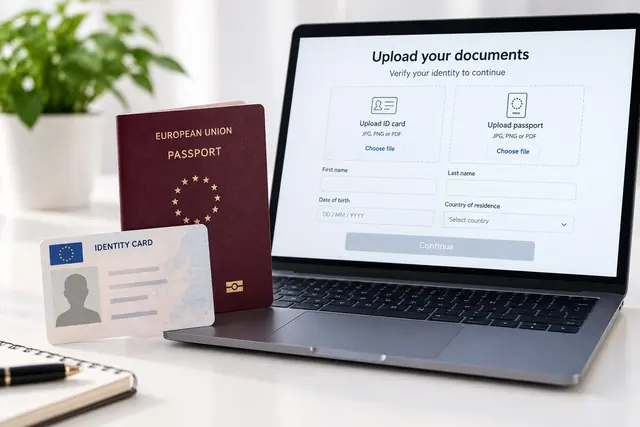
Every account that can hold money and pay it out is subject to the same identity and source-of-funds machinery regardless of how little passed through it. A five-euro deposit does not buy a lighter version of know-your-customer. You will be asked for proof of identity and proof of address, and depending on the operator and the rail, proof that the payment instrument belongs to you.
The timing varies and it matters. Some operators verify at registration, which front-loads the work and means the first withdrawal is clean. Others verify at first withdrawal, which means the documents land in a queue precisely when you want to be paid. If the choice is visible, front-loading is better, because a document review on a small balance is a low priority for everybody involved and the wait can be disproportionate to the sum.
The thing to avoid is a mismatch between the name on the account and the name on the payment instrument. Depositing from a card or wallet belonging to someone else is a breach of terms at every operator worth using, and at the small end it happens accidentally, usually with a family member's card. The deposit will go through; the withdrawal will not, and unwinding it is far more trouble than five euro justifies.
Fees, dormancy and the stranded remainder
Small balances have a particular failure mode: they get abandoned. A couple of euro left after a session is not worth the friction of a withdrawal that is below the floor anyway, so it sits. Operators have dormancy clauses that specify what happens to an account with no activity over a defined period, and those clauses can include administrative deductions or, eventually, closure.
None of that is sinister and all of it is in the terms. But it is the reason a small deposit should be treated as a complete transaction rather than an open position. Either play the balance out, or withdraw it if it clears the floor, or close the account. Leaving it is the only option with an ongoing cost attached, and it is the option most people take by default.
On the fee side, the deposits themselves are usually free at Irish-facing operators, and that is genuinely the norm rather than a promotional claim. Where fees appear is on the periphery: a prepaid maintenance deduction, a crypto network charge, a currency spread, occasionally a payout fee on a specific rail. Each is small in absolute terms and each is a meaningful percentage of a five-euro cycle, which is the recurring theme of this entire page.
Licensing: who stands behind a small deposit in Ireland

Ireland has been rebuilding its gambling framework. The Gambling Regulation Act 2024 established the Gambling Regulatory Authority of Ireland, and the Authority is standing up its functions in stages rather than all at once. Several parts of the Act, including the Part 6 regime covering advertising, promotion and inducements, are on the statute book but have not yet been commenced, so they are not yet operative rules you can hold an offer against.
What that means practically for a five-euro depositor is that the terms governing your bonus are, for now, mostly the operator's own terms read against the rules of whichever jurisdiction licenses it. The protections that matter to you in that situation are the ones a licence actually guarantees: segregation of player funds, a published complaints route, an independent dispute service, and tested game software. Those are checkable on an operator's own footer in a couple of minutes.
The GRAI publishes its remit and its licensing progress itself, and it is the right primary source rather than a secondary summary. For the wider question of how to tell a properly run site from a badly run one, including the footer checks and the warning signs in terms and conditions, we keep a separate method page and it is worth reading before you fund anything, at any amount.
Keeping control when the stake looks trivial

The genuine risk at this rung is not the five euro. It is the sequence of five euros. A deposit small enough to feel inconsequential is a deposit easy to repeat, and ten repetitions of an inconsequential amount is a real amount of money that never triggered the moment of hesitation a larger single deposit would have.
The tools that address this are built into every properly licensed cashier and they all work better set in advance than in the moment. A deposit limit over a period caps the sequence rather than the instance. A loss limit caps the outcome. A session reminder interrupts the drift. Time-out and self-exclusion exist for when the limits are no longer enough, and using them is not a failure, it is the system working as designed.
If gambling has stopped being an occasional expense and started being something else, the Irish support services are free, confidential and independent of any operator, and the honest thing for a page like this to do is point at them rather than at another offer. Our responsible gambling page lists the Irish helplines and explains what each tool does. Play with money you have already decided to lose, and treat anything that comes back as a surprise rather than a plan.
A ten-minute audit of any five-dollar claim
When a page promises a five-dollar or five-euro deposit, you can confirm or demolish the claim quickly, and the order of the checks is what makes it fast. Start at the cashier, not the landing page, because the landing page is marketing and the cashier is the system of record.
Check one: find the deposit minimum per method, not the site-wide figure. Check two: open the bonus terms and find the qualifying minimum and the excluded methods, which are frequently in the same clause. Check three: find the withdrawal minimum and compare it with the deposit you are planning. Check four: find the verification timing, before or at first withdrawal. Check five: confirm the rail you want to deposit with can also receive a payout, and if it cannot, decide now which one will.
Five checks, each of them a search within a page you already have open. If any of them cannot be answered from the operator's own documentation inside ten minutes, that is itself the answer. A site that makes its own payment floors hard to find is telling you something about how it will handle a dispute later, and at this deposit size the dispute is the expensive part, not the money.
So who is the five-euro rung actually for?
It is for three kinds of player and genuinely bad for a fourth. It suits the person testing an operator's plumbing before committing: fund small, play a little, request a payout, and judge the site on how that payout behaves rather than on its ranking table. It suits the person who wants a short, cheap, bounded hour of entertainment and has no expectation of a return. And it suits the person who has found a wager-free spin package with a sane qualifying minimum, because that is the one configuration where the small deposit is doing real work.
It is bad for the person chasing a bonus. At this rung the match is small, the turnover obligation attached to it is not proportionally small, and the mathematics of clearing a requirement on a short bankroll are unforgiving. If a bonus is the reason you are depositing, the rung above is a more honest place to do it, and our ten euro deposit page covers what changes there.
The dollar in the search query, in the end, was never the point. It was a size signal borrowed from a louder market. The useful translation is: roughly a fiver, in euro, on a rail that will also pay you back, with the bonus terms read before the deposit rather than after. Do those three things and the rung works exactly as advertised. Skip any of them and the complaint you end up writing will not be about the currency.
Frequently asked questions
Can I actually deposit 5 dollars at an Irish online casino?
Not in dollars, no. An Irish-facing cashier is denominated in euro, so the field you type into is a euro field and the minimum it validates against is a euro minimum. In practice the query means roughly five units of currency, and the answer is that most common rails will accept a five-euro deposit. If the account you fund from holds dollars, your own provider converts and applies a spread; the casino is not involved in that part.
Why was my five-euro deposit declined when the site says it accepts it?
Almost always because two different floors exist. The casino publishes a site-wide minimum, and the payment provider enforces its own; the higher of the two applies. The other common cause is a block you control: a gambling toggle in your banking app, or a merchant category restriction on the card. The cashier only ever sees the word declined, so the real reason is in your banking app rather than in the casino's error message.
Will a five-euro deposit qualify for the welcome bonus?
Sometimes, and you cannot tell from the deposit minimum. Offers carry their own minimum qualifying deposit, which is a separate figure in a separate document, and many of them sit above this rung. Some offers also exclude specific e-wallets and prepaid instruments from qualifying regardless of amount. Read the bonus terms first, then choose the rail, then type the amount; doing it in the other order is how people end up funded with no offer attached.
What is the difference between this and the five euro deposit page?
The euro page is the full method-by-method treatment of the rung for the Irish market. This page exists because the query arrives in dollars, so it deals with the currency confusion, the conversion chain, and specifically what changes in the bonus column when you step up from the absolute minimum deposit. There is deliberately little overlap: if you want the straight payments comparison, the euro page is the better read.
Can I withdraw a five-euro deposit if I change my mind?
Usually not as five euro. The minimum withdrawal at most operators sits above this amount, which means a deposit this size can only leave the account if it grows past that floor. That is a processing-cost decision rather than a trick, but the consequence is real: at this rung a deposit behaves like a spend rather than a stake. Decide you are willing to lose it before you make it.
Which payment method is best for a five-euro casino deposit in Ireland?
A fintech card or account is usually the smoothest in practice: it passes the amount, it is already in most Irish pockets, and it can receive the payout. Open banking is the better pick if you expect to withdraw, because paying in from your own bank account establishes a verified link that smooths the first payout. Prepaid and phone billing work on the way in but cannot pay you out at all.
Does crypto make a five-dollar deposit cheaper?
No, generally more expensive. Crypto has no nominal minimum, but the network fee is charged per transaction rather than per euro, so it takes a far bigger bite out of a small deposit than a large one. A volatile coin adds a second problem: the credited amount is the value at confirmation, not at send, which can drop you under the cashier's floor. Stablecoins remove the volatility and leave the fee.
How many spins does five euro buy?
It is pure division before variance. Hypothetically, a five-euro balance covers fifty spins at ten cent, twenty-five at twenty cent and ten at fifty cent. Returns during the session lengthen that; a bonus max-bet rule may cap the stake and change it. Those are conditional figures used to show the shape, not a prediction, and no stake size changes the house edge applied to every spin.
Do I still have to verify my identity for such a small deposit?
Yes, in full. Verification requirements do not scale with the amount: the same identity and address checks apply whether you deposited five euro or five hundred, and some operators also want proof the payment instrument is yours. The only thing that varies is timing. Being verified at registration rather than at first withdrawal is better, because a document queue on a small balance is nobody's priority.
Who regulates casinos for Irish players right now?
The Gambling Regulation Act 2024 established the Gambling Regulatory Authority of Ireland, and it is taking on its functions in stages. Parts of the Act, including the Part 6 regime on advertising, promotion and inducements, have not yet been commenced, so they are not yet operative rules. Until they are, the terms governing your bonus are the operator's own, read against the rules of whichever jurisdiction licenses it.
Is depositing small repeatedly safer than depositing once?
It feels safer and often is not. An amount small enough to seem inconsequential is an amount easy to repeat, and a sequence of trivial deposits adds up to a real one without ever triggering the hesitation a single larger payment would. The fix is a deposit limit over a period rather than per transaction, set in advance in the cashier, so the cap applies to the sequence and not just the instance.
Are there fees on a deposit this small?
The deposit itself is usually free at Irish-facing operators. The costs sit around the edges: a currency spread if any account in the chain is not in euro, a network fee on crypto, a maintenance deduction on a partly spent prepaid PIN, occasionally a payout fee on a specific rail. Each is tiny in absolute terms and a meaningful percentage of a five-euro cycle, which is the whole arithmetic problem at this rung.
Read next
More in Bonuses
Casino free spins50 free spins100 free spinsCashback casinoCasino bonus codes
300 free spins Claim the bonus 18+ · Bonus terms in the WINSHARK rules