
$1 deposit casinos seen from Ireland: why the cashier still counts in euro
 Best casinos available in IrelandUpdated 7 November 2026



"One dollar deposit casino" is one of the most-searched phrases in online gambling, and almost none of it was written for Ireland. The term comes from markets where the dollar is the local currency, and when it surfaces in an Irish search result it arrives with a currency problem attached: your money is in euro, the cashier floor is set in euro, and somewhere between the two a conversion is waiting. This guide explains where the dollar figure actually comes from, who converts what and at which point, what the euro equivalent of a dollar deposit really is, and why the smallest deposit question in Ireland has nothing to do with dollars at all.

 300 free spins Claim the bonus 18+ · Bonus terms in the WINSHARK rules
Short answerA no deposit bonus casino offer is bonus money or free spins credited after sign-up, before you pay anything in. You can win real money with it, but only after meeting the wagering, staying under the max bet, passing verification and accepting a cap on what you can withdraw. Our partner WINSHARK does not run a no deposit offer; its welcome deal is +250% on your deposit.
- Formats
- free cash, free spins, free chips, free play
- Between you and a payout
- wagering, max bet, max cashout
- ID check
- usually before the first withdrawal
- Age
- 18+ only
- GRAI online casino licences
- none issued yet (October 2026)
- WINSHARK welcome offer
- +250% on your deposit, a deposit bonus
Why an Irish search turns up a dollar figure at all

The phrase is an import. Minimum-deposit marketing in the dollar form was built for markets where the dollar is the everyday currency — most visibly New Zealand, Canada and Australia, where a one-dollar or five-dollar deposit tier is a genuine product category with operators competing on it. Those pages were written, optimised and linked at enormous volume, and search engines do not stop serving a well-established page just because the reader's currency has changed.
Two further things keep the dollar phrasing alive in Irish results. The first is that a lot of casino content is produced centrally and localised lightly, so a page can carry dollar terminology while nominally addressing a euro audience. The second is that the dollar is the industry's internal lingua franca: affiliate reporting, game supplier pricing and much platform configuration are discussed in dollars even when no player ever sees one.
The consequence for you is a mismatch rather than a trick. There is no reason to expect an Irish-facing cashier to offer a dollar tier, and no reason to treat the absence of one as a restriction. The real question hiding behind the search is "what is the smallest deposit I can actually make from Ireland?", and that is a euro question answered by the method you choose. The tiers that exist as published steps for Irish players are set out on our minimum deposit guide, and the bottom of that ladder is the honest comparison for anyone who arrived here searching in dollars.
Three different currencies hide inside one deposit
Any casino deposit from Ireland involves up to three currencies, and the confusion in this whole topic comes from collapsing them into one. Separating them makes everything else straightforward.
The first is your funding currency: what the money is denominated in where it sits now — a euro current account, a euro card, a multi-currency fintech balance, or a coin holding. The second is the account currency: the currency your casino balance is denominated in, chosen at registration and usually impossible to change afterwards. The third is the settlement currency: what the operator's payment processing is actually done in, which you may never see and which can differ from your account currency.
A conversion happens at every point where two of these differ. If you fund a euro account from a euro card, nothing converts and the dollar question never arises. If you fund a dollar-denominated account from a euro card, your issuer converts and the spread applies. If your euro account is settled in another currency behind the scenes, the operator absorbs that cost and you see it only indirectly, as limits and fees that look slightly arbitrary.
This is why the single most useful action you can take on any site quoting dollars is to find out what currency your account is in. It is usually shown in the cashier beside the balance and in the account settings, and it determines everything: the floor you must clear, the figures in the bonus terms, the withdrawal minimum and whether a conversion stands between you and your own money. The rail-by-rail picture of where those conversions land is on our payment methods page.
| Layer | What it is | Who sets it | What it decides |
|---|---|---|---|
| Funding currency | The denomination of the money before it moves | Your bank, card issuer or wallet | Whether your side converts, and at whose rate |
| Account currency | The denomination of your casino balance | Chosen at registration, rarely changeable | The deposit floor, bonus thresholds and payout minimum |
| Settlement currency | What the operator's processing is done in | The operator and its payment providers | Costs you see indirectly, as limits rather than fees |
Why "one dollar" has no fixed euro equivalent
A dollar tier cannot be translated into a euro tier once and left alone, because the relationship between the two currencies moves continuously. That sounds obvious stated plainly, and it is routinely ignored in practice by pages that publish a converted figure as though it were a limit.
Exchange rates move on every trading day, sometimes materially within one. A deposit tier is a configuration value in a cashier that changes only when somebody edits it. Put those two facts together and you get an unavoidable drift: any euro figure presented as "the equivalent of one dollar" was true at an unstated moment and is approximately true now at best. We deliberately publish no rate on this page, because a rate printed in an article is wrong by the time it is read.
This has a practical consequence that matters more than the arithmetic. If an operator genuinely runs a dollar-denominated tier and you hold a euro account with them, the amount you must deposit in euro to clear that tier is not fixed — it is whatever the conversion produces today. Players who budget to the cent find a deposit rejected for being a fraction short, which reads like a malfunction and is just foreign exchange. The defence is to deposit a little above any threshold expressed in a currency other than your account currency, and to read the confirmation screen rather than assuming.
The same drift explains why the lowest Irish rung is quoted in euro and stays there. A euro floor on a euro account is a stable number you can plan around, which is exactly what our one-euro deposit page is able to describe concretely in a way no dollar page can for an Irish player.
The conversion chain: who converts, and where the spread sits
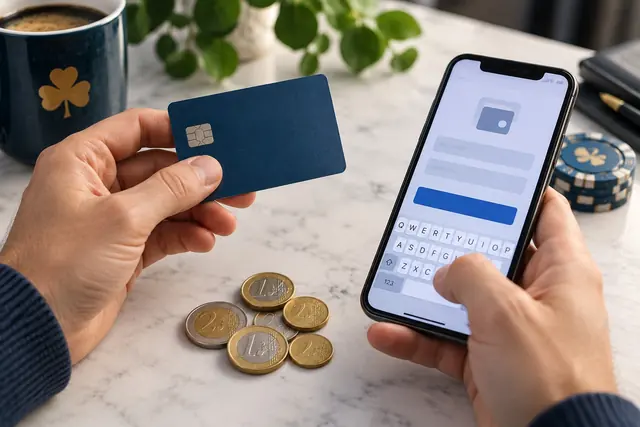
Currency conversion is a service, and the party performing it keeps a margin — the gap between the rate they use and the rate at which currency is actually trading. That margin is the real cost of a cross-currency deposit, and it is almost never presented as a fee.
There are four plausible places in the chain where the conversion can happen, and they are not equally priced. Your bank or card issuer can convert when the transaction is presented in a foreign currency, using their own published approach. The card scheme can convert, using the network's rate, when the merchant presents in one currency and your card is in another. The merchant or its payment provider can convert at the point of payment, which is where the offer to "pay in your own currency" comes from. Or your fintech or multi-currency account can convert before the money leaves, at whatever terms that app applies.
The important structural point is that only one of these should happen per transaction. When two occur — because you converted in your app and the merchant also converted at the till — you have paid two margins on the same money. That double conversion is the single most expensive mistake available in this area, and on a very small deposit it is proportionally brutal, because the margins are percentages applied to an amount so small that the absolute figures look harmless.
Which party gets to convert is decided by choices you make in the cashier and in your card settings, not by the casino. The card-side mechanics, including how a foreign-currency presentment appears on an Irish statement, are covered on our Visa page and our Mastercard page.
The "pay in your own currency" prompt and why to decline it

If you have ever been offered the choice between paying in euro or in the merchant's currency at a foreign checkout, you have met dynamic currency conversion. The merchant's provider offers to do the conversion for you and show you a euro figure up front, which feels helpful and is usually the more expensive of the two options.
The mechanics are simple enough. Declining the offer means the transaction is presented in the merchant's currency and your issuer or the card scheme converts, applying their approach. Accepting means the merchant's provider converts and sets the rate, with their margin built in, and your issuer sees a euro transaction and does nothing further. The second route guarantees certainty about the figure and gives away the ability to shop the rate.
At a casino cashier this appears in several disguises: a currency selector beside the amount, a note saying the charge will appear in euro, or a pre-converted figure shown with an "approximate" qualifier. The general rule travellers learn applies here too — let your own provider convert unless you have a specific reason not to — but with one casino-specific caveat. If the account is dollar-denominated, declining the merchant's conversion does not avoid conversion; it only moves it. The only way to avoid conversion entirely is for your account currency and funding currency to match.
One further detail worth knowing: a conversion performed at the cashier is not necessarily reversed on the same terms when you withdraw. The two directions are separate transactions with separate margins, which is the subject of the round-trip problem further down this page.
Can you even hold a dollar account from Ireland?
Sometimes, and it is worth knowing when, because the answer shapes everything else. Operators offer a list of account currencies at registration, and the list depends on their licence, their payment providers and the markets they serve. A site built for several markets often includes the dollar, the euro and sterling; a site built for Europe may offer euro alone.
Where a dollar account is available to an Irish registrant, choosing it is almost always the wrong decision. Your funding is in euro, your withdrawals will go back to euro, and you have inserted a conversion into both legs of every transaction for no benefit. The exception is narrow: a player whose income or holdings are genuinely dollar-denominated, for whom the euro would be the foreign currency.
There is also a practical trap in the opposite direction. Because the account currency is usually fixed at registration, a dollar account chosen carelessly on day one cannot normally be changed later — the remedy is a new account, which means fresh verification and, often, the loss of any loyalty status. It is a thirty-second decision with a long tail, and it is made on a screen most people click through.
If a site presents dollar figures throughout its marketing but offers only euro accounts, that is simply unlocalised copy and nothing is wrong. If it presents euro figures and then opens a dollar-denominated account for you, that is worth a question to support before depositing. The broader method for auditing an operator before trusting it with money is on our page on comparing and auditing Irish casino sites.
Sterling, the border and why three currencies are in play
Ireland is unusual in one respect that this discussion normally ignores: for a significant number of players, there is a third currency in daily life. Sterling is the currency a few hours up the road, it is the currency of a large share of the English-language gambling industry, and it appears in cashier currency lists far more often than the dollar does. Anyone living near the border, working across it, or holding a sterling account for other reasons meets exactly the same conversion questions this page describes, just with a different pair.
The mechanics are identical and the conclusion is identical: match the account currency to the currency the money is actually in, and if the money exists in two currencies, pick the one you will be paid back into. What is different is the volume of material written for a sterling audience, which is why a lot of guidance an Irish reader finds — deposit tiers, promotional structures, payment habits — is describing a neighbouring market rather than this one. The payment landscape differs in concrete ways too: card and open-banking usage patterns, the role of fintech apps, and which wallets are widely held.
There is also a licensing dimension that currency makes easy to misread. A site presenting prices in sterling is often built for a neighbouring regulatory regime, with that regime's rules on advertising, affordability checks and payment restrictions baked into the product. Those rules may be stricter or looser than what applies to you, and either way they are not yours. The currency on the page is a hint about who the product was designed for, which is useful information even though it tells you nothing about the floor in your own account.
The practical summary for an Irish player choosing an account currency comes down to the table below, and in all but one row the answer is the same.
| Account currency | Conversion on the way in | Conversion on the way out | Sensible for whom |
|---|---|---|---|
| Euro | None, if funded from a euro source | None, if paid back to a euro account | Almost everyone based in Ireland |
| Dollar | Yes, unless you already hold dollars | Yes, back to euro | Only a player whose money is genuinely dollar-denominated |
| Sterling | Yes, unless funded from a sterling account | Yes, unless paid to a sterling account | Cross-border earners who hold and spend sterling |
| Coin or stablecoin balance | Yes, at the exchange, plus network cost | Yes, on the way back to euro | Players already operating in crypto for other reasons |
Multi-currency fintech accounts: the one genuine workaround

The only clean way an Irish player can fund a dollar-denominated casino account without a conversion at the point of payment is to already hold dollars. Multi-currency fintech accounts make that possible: you convert euro to dollars inside the app when you choose to, hold the dollar balance, and then pay from it.
What this achieves is control over the timing and the terms of the conversion, which is a real improvement over having it done to you mid-checkout. What it does not achieve is the elimination of the conversion — the euro still had to become dollars at somebody's rate. It also introduces two wrinkles specific to these apps: conversion terms can differ at weekends, when the underlying markets are closed, and card payments from a multi-currency account can route through the balance you did not intend unless the app's currency-priority settings are set deliberately.
There is a casino-side complication too. Operators look at the payment instrument's characteristics, and a card attached to a fintech account is sometimes classified differently from a bank debit card, which can matter for bonus eligibility even when the deposit itself is fine. The routes a fintech account can take to reach a cashier, and how to tell from the receipt which one was used, are set out on our Revolut page.
For the specific question this page is about, the conclusion is deflating in a useful way. A multi-currency account lets you make a genuine dollar deposit from Ireland, at a cost you can see and schedule. It does not make a dollar deposit cheaper than the equivalent euro deposit at a euro-denominated site, which remains the simplest option for almost everybody.
Wallets and the currency you forgot you chose

Dedicated e-wallets sit in the middle of this problem and are the place where double conversion most often happens unnoticed. A wallet account has its own currency, often set when it was opened and frequently left at whatever was offered by default. If that currency is the dollar and your funding is in euro, the wallet converts on the way in; if the casino account is in euro, the wallet or the casino converts on the way out of the wallet. Two conversions, one deposit, and nothing on the screen says so.
The way to check is dull and quick: open the wallet, look at which balance the money will actually leave from, and look at what currency the casino's cashier says it will receive. If those differ, a conversion is happening and it is worth knowing whose. Wallet providers also distinguish between holding a currency and displaying it, so a balance shown in euro is not proof the underlying balance is in euro.
Wallets do have a genuine advantage in this area. Because they sit between your bank and the casino, they let you consolidate conversions: convert once, in a sensible amount, at a moment you chose, and then make several deposits from the converted balance without converting again. For anyone making frequent small deposits across currencies, that is the difference between paying a margin once and paying it repeatedly. The wallet products available to Irish players and their payout behaviour are compared on our Neteller page.
The disadvantage is the familiar one: wallets appear on bonus exclusion lists more often than cards and bank rails, so the method that solves your currency problem may create an eligibility one.
What a dollar-sized deposit means against a euro floor
Strip away the currency and the question becomes concrete. A dollar is an amount of money in the same neighbourhood as a euro, so "can I deposit one dollar?" from Ireland is really "can I deposit roughly a euro?" — and that is a question with a clear answer, set by the method rather than the currency.
The lowest published rung on Irish-facing cashiers is generally a single euro, available on a narrow set of rails. Below that, nothing meaningful exists: there is no half-euro tier, because the processing cost of a deposit does not shrink with the amount and no operator has a reason to configure one. So if the dollar figure that brought you here is smaller than the euro floor after conversion, the deposit will be rejected, and the rejection is arithmetic rather than policy.
This is where the dollar search and the euro reality meet most usefully. An Irish player wanting the smallest possible deposit should look for a euro-denominated account at a site whose floor for their chosen rail is the lowest rung, and should ignore the dollar framing entirely. What that smallest rung actually gets you — in session length, in bonus reach, in whether a withdrawal is even possible — is the subject of our one-euro page, and the answer is more interesting than the currency question.
One pattern worth naming: conversion makes thresholds fuzzy in a way that catches careful people. A deposit of exactly the converted equivalent of a dollar can land a fraction below a euro floor and bounce. Deposit a little above any threshold you reached by conversion, always.
Where conversion can happen, and what it costs you
The table below sets out the points in a cross-currency deposit where a margin can be taken. It deliberately contains no percentages, because conversion terms vary by provider, by card, by currency pair and sometimes by day of the week, and any figure printed here would be misleading within a month.
What the table is for is diagnosis. If a cross-currency deposit cost more than you expected, the cause is one of these rows, and identifying which one tells you what to change. In most cases the fix is not to switch casino but to switch which party does the converting, or to remove the need for conversion altogether by matching your account currency to your funding currency.
| Where it happens | Who sets the rate | How you spot it | How to avoid it |
|---|---|---|---|
| Your fintech or multi-currency app | The app, at the moment you convert | A conversion line in the app's history | Convert deliberately, in larger and less frequent amounts |
| Your bank or card issuer | The issuer's own approach to foreign transactions | A foreign-currency transaction on the statement | Fund an account held in your own currency |
| The card scheme | The network's rate for the pair | The statement shows a converted euro amount | Unavoidable once the presentment is foreign |
| The cashier's own converter | The merchant's payment provider | A "pay in EUR" prompt or a pre-converted figure | Decline the offer unless the account is foreign anyway |
| The casino's internal crediting | The operator, for coin or cross-currency balances | Balance credited differs from the amount sent | Check the account currency before depositing |
| The withdrawal leg | Whoever converts on the way back | Payout smaller than the deposit implies | Match account and funding currency from the start |
The round trip: converted in, converted out
The cost of cross-currency play is not the conversion. It is the pair of conversions, and most discussions stop after the first one.
Consider the shape of it as a hypothetical illustration, with invented figures used only to show the mechanism. Suppose you convert euro into a dollar balance and a margin is taken. You deposit, you play, and suppose you finish with the same nominal amount you started with — no winnings, no losses, which never happens but isolates the currency effect. You withdraw, and the dollars convert back to euro, and a margin is taken again. You are now holding less euro than you started with, having neither won nor lost at any game. The money went to the conversion, twice.
Now add the house edge, which is the real cost of casino play, and the picture is clear: cross-currency play adds a fixed drag on top of a game's negative expectation, applied to the full amount in both directions rather than only to what you lose. On small amounts the absolute figures are trivial; as a percentage of a small deposit they are not, and the percentage is what compounds if you deposit and withdraw repeatedly.
The conclusion is simple and it is the practical heart of this page. If you are in Ireland, hold a euro account and fund it in euro. The dollar framing in the search results is not an opportunity you are missing out on; it is a cost you are being offered. The timing mechanics of the withdrawal leg, which is where people usually notice the second conversion, are on our page about getting paid sooner.
Euro-funded, euro account, no conversionbaseline index = 100
One conversion on the way inillustrative
Conversion in and out, one providerillustrative
Double conversion in, single outillustrative
Double conversion both directionsillustrative
Entirely hypothetical illustration. The index shows how much of a deposit survives a round trip as conversion layers are added, with game outcomes held neutral; the numbers are invented to show the mechanism and are not any provider's rates.
Crypto: dollar-denominated without any dollars

Cryptocurrency complicates the currency question in an interesting way, because much of the ecosystem thinks in dollars while touching none. Coin prices are quoted against the dollar by convention, stablecoins are overwhelmingly dollar-referenced, and casino crypto cashiers frequently display dollar equivalents regardless of where the player is.
For an Irish player this creates a three-step chain. Euro becomes coin at an exchange, at a rate and a fee. Coin moves to the casino, at a network cost unrelated to the amount. Coin is credited either as a coin balance or converted to the account currency at the operator's own rate. Each step has a margin, and the middle one is the only cost that does not scale with the amount — which is why small crypto deposits are economically poor no matter how the amount is denominated.
Stablecoins remove the price volatility but not the conversion. A dollar-referenced stablecoin is still a foreign currency to a euro holder; the euro-to-stablecoin step carries the same exchange question as euro to dollars, with the added question of whether the stablecoin's reference holds. The coin choices, the crediting mechanics and the Irish tax and risk angles are set out on our crypto casino page, and the deposit and payout specifics of the largest network are on our Bitcoin page.
There is one respect in which crypto genuinely answers the question in this page's title: a one-dollar-equivalent deposit is technically possible on networks with negligible fees, in a way it is not on card rails bound by operator floors. Whether that technical possibility is worth the three-step chain for an amount that small is a different matter, and for most players the answer is no.
Why operators market in dollars and settle in euro

It is worth understanding the commercial logic, because it explains why the mismatch persists rather than being fixed. Casino marketing is produced at scale, and the dollar is the industry's default unit of account: supplier contracts, affiliate commission schedules, platform fees and internal reporting are frequently dollar-denominated even for operators with no dollar-market players.
Localisation is then applied as a layer, and layers are applied unevenly. Currency symbols in body copy get missed more often than currency symbols in cashiers, because the cashier is a functional system that would break, while the body copy merely reads oddly. The result is pages that quote dollars while offering euro accounts — sloppy rather than deceptive, in most cases.
Where it stops being merely sloppy is in threshold claims. A deposit floor, a qualifying deposit or a withdrawal minimum stated in the wrong currency is not a cosmetic error, because a reader will plan around the number. If a page tells an Irish player a promotion qualifies at a dollar figure and the account is in euro, the figure that actually applies is the euro one in the terms, and the difference is the reader's problem rather than the publisher's.
The practical reading rule: on any site quoting mixed currencies, treat the cashier and the formal terms as authoritative and treat the marketing copy as approximate. If the two disagree about a number that matters, ask support in writing before depositing, and keep the answer. Operators whose terms and cashier agree with each other are demonstrating basic competence, which is one of the signals our page on spotting a legitimate site treats as a positive.
Bonus thresholds are set per currency, not converted

This is the currency detail most likely to cost you something concrete. When an operator runs a promotion across multiple account currencies, the qualifying deposit is set separately for each currency, at a round number in that currency. It is not converted from a base figure at today's rate — it is configured, once, at a value the marketing team considered comparable.
Two consequences follow. First, the thresholds in different currencies are rarely exact equivalents, and the gap moves as rates move. A promotion's dollar threshold and euro threshold can drift noticeably apart without anybody editing anything. Second, and more practically, the only threshold that applies to you is the one in your account currency. Reading a dollar figure from an international version of an offer page and planning a euro deposit around it is a reliable way to deposit a qualifying amount that does not qualify.
The same applies to every other number in a bonus: maximum bonus amounts, winnings caps, maximum bet while a bonus is active, and minimum withdrawal. All of them are per-currency configuration values, all of them appear in the terms in your account currency, and none of them should be reconstructed by conversion. The maximum-bet rule deserves particular care, because breaching it can void a bonus and the figure is small enough that a conversion error could push you over it without any intent.
None of this means currency makes bonuses worse. It means the terms must be read in the currency your account is actually denominated in — and that very small deposits, in any currency, sit below the qualifying thresholds that promotions use. The general mechanics of offers that ask for nothing up front are covered on our no-deposit bonus page, which is the one format where the deposit currency question does not arise at all.
Withdrawal floors, and the balance too small to collect

The deposit side gets all the attention and the withdrawal side causes the problems. Operators set a minimum withdrawal, it is generally higher than the minimum deposit, and it is denominated in your account currency. A player who deposits a dollar-sized amount has, in almost every case, funded a balance below the amount they are permitted to take out.
Add a currency mismatch and a second effect appears. If the withdrawal converts back to euro, the amount that reaches your bank is the converted figure less whatever margin applies, so a balance that just clears the floor in account currency can arrive looking smaller than you calculated. Nothing has been taken improperly; conversion simply happened on the way out as it did on the way in.
There is also a method-matching constraint that currency makes worse. Operators often return funds by the method used to deposit, and some rails cannot receive money at all, so the payout may have to go to a second method which itself may be denominated differently. Three currencies in a chain of two payments is where people genuinely lose track of what they are owed.
The way to keep this simple is the same as everywhere on this page: one currency, end to end. A euro account funded from a euro source and paid back to a euro destination has no conversion anywhere, no mismatch between the floor you read and the floor that applies, and no gap between the figure you requested and the figure that arrives. The practical mechanics of the payout process, including the difference between an approval and funds landing, are on our withdrawal timing page.
Reading terms when the currency is ambiguous
Ambiguous currency notation is more common than it should be, and a few habits remove most of the risk. The dollar sign in particular is ambiguous by design: it serves several national currencies, and a page aimed at more than one market may use it loosely.
Four checks cover nearly everything. First, find the three-letter currency code rather than relying on a symbol, because the code is unambiguous while the symbol is not. Second, confirm the currency of your own account in the cashier, which overrides anything in the marketing. Third, check whether the terms you are reading are the general terms or a market-specific annex, since many operators publish both and the annex governs. Fourth, check whether the terms page is dated or versioned, because currency thresholds change and an undated page cannot be relied on if you ever need to argue about what applied.
One more habit is worth building: screenshot the cashier and the relevant clause before a deposit that matters. Terms change without notice, and the only evidence of what applied on the day you played is the copy you kept. This costs nothing and settles disputes that would otherwise be your word against a changed page.
If a site cannot tell you clearly, in its own terms, what currency your account is in and what the floors are in that currency, that is not a currency problem. It is an operational competence problem, and it is the kind of signal worth more than any promotional headline when deciding where to play real money at all, as our real money casino guide argues at length.
Red flags on pages selling a dollar deposit to Irish readers
Because this search term has volume and no local product behind it, the pages competing for it tend to share a set of tells. These are the ones we treat as disqualifying.
- A euro figure presented as the fixed equivalent of a dollar. Rates move; configuration values do not. A single converted number is a snapshot of an unstated moment.
- No mention of account currency. If a page discusses dollar deposits for an Irish audience without saying which currency the account is denominated in, it has skipped the only variable that matters.
- Operator lists with one figure per row. Floors are set per payment method, so a single number per casino has flattened the real variable, exactly as it does on euro-tier pages.
- Bonus claims attached to a dollar-sized deposit. Qualifying deposits sit well above cashier floors in every currency. This is the clearest sign a page is written to rank rather than to inform.
- Silence on the withdrawal minimum. Any page discussing the smallest possible deposit without the corresponding payout floor is omitting the half that can trap your money.
- No mention of conversion at all. A cross-currency deposit always converts somewhere. A page that does not say so has not thought about it.
- Copy that reads as translated or recycled. Dollar-market phrasing left in an Irish-facing page means nobody checked anything locally.
The constructive alternative is to ignore currency framing entirely and ask the two questions that have answers: what is the floor for my method in my account currency, and what is the withdrawal minimum in the same currency? Everything else on a dollar-deposit page is decoration.
How the deposit shows up on an Irish bank record
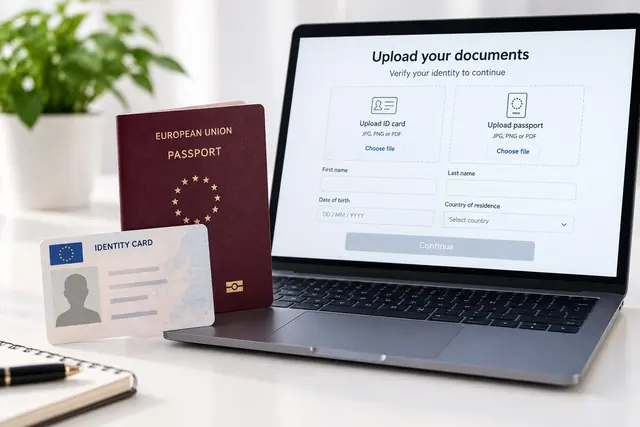
Cross-currency transactions look different on a statement, and the differences are worth recognising because they are the easiest way to audit what actually happened.
A euro transaction to a euro merchant shows one line, one amount, no conversion note. A foreign-currency transaction typically shows the original amount in the merchant's currency alongside the euro amount charged, and in some presentations a rate or a conversion note as well. If you see only a euro figure for a transaction you expected to be foreign, the merchant's provider probably converted at the point of payment — the prompt discussed earlier — and your issuer saw a domestic euro charge.
Gambling transactions also carry a dedicated merchant category code, which means your bank can identify them regardless of currency or amount. That matters in two ways. Irish banks commonly decline gambling transactions on credit cards and offer customer-controlled gambling blocks that apply to debit cards, so a declined deposit may never have reached the casino at all. And the trail is durable: a pattern of gambling payments is visible in a statement long after the sessions are forgotten, which is relevant in contexts such as lending assessments that have nothing to do with casinos.
On the tax side, the general Irish position is that gambling winnings are not treated as income for a recreational player and betting duty falls on the bookmaker rather than the punter. That is a general statement rather than advice about your circumstances. Currency conversion does not change it, though anyone dealing in crypto should note that the coin side of the chain raises its own questions and is worth proper professional advice rather than a casino guide's summary.
Ireland's regulatory position, and why currency does not change it

A question that follows naturally from all of this: if a site quotes dollars and settles elsewhere, who regulates it for an Irish player? The currency is a red herring, but the underlying question is a good one.
Ireland's framework is mid-transition. The Gambling Regulation Act 2024 created a statutory regulator, the Gambling Regulatory Authority of Ireland, generally referred to as GRAI. The Authority has been established and is building out its functions, including the apparatus needed to license remote gambling. The licensing provisions are being brought into force in stages and that process is not complete, so it would be wrong to say an Irish remote licensing regime is already operating, and equally wrong to say the landscape is unchanged.
Until the regime is fully in force, the licences behind sites serving Irish players are issued in other jurisdictions, which is why the licence check matters more than the currency on the page. A licence determines which authority hears a complaint, what dispute resolution you can access, what segregation of player funds applies and what advertising and inducement rules bind the operator. None of that is affected by whether the marketing copy says dollars or euro.
The Act also provides for measures that will reach the subjects of this page: controls on payment methods and the use of credit, restrictions on inducements, and a national exclusion register. Each takes effect as the relevant sections are commenced. Alongside the statutory position there is support available today, independent of any operator — the tools and services listed on our responsible gambling page, including Problem Gambling Ireland and Gamblers Anonymous Ireland.
A ten-minute test of how a site handles your currency

Everything above can be verified on any specific site in the time it takes to make a cup of tea, and the test is worth more than any comparison because it describes the account you actually hold.
- At registration, read the currency selector carefully. It is usually a single dropdown clicked past in a second, and it is usually irreversible. Choose euro unless you have a concrete reason not to.
- Verify before depositing. Identity and address checks are required regardless of amount or currency, and completing them early removes the most common cause of a stuck balance.
- Find three numbers in the terms, in your account currency. The minimum deposit for your method, the minimum withdrawal, and the qualifying deposit for any offer you care about. Write them down.
- Probe the floor. Type an amount below what you intend and read the rejection: it usually states the real minimum for that method, which is more current than any published figure.
- Watch for a conversion prompt. If the cashier offers to charge you in euro for a non-euro account, note the terms and, in general, let your own provider convert instead.
- Deposit a small amount and read the receipt. Compare three figures: what you sent, what your statement shows, and what the balance was credited. Any gap between them is a conversion, and now you know where it happened.
- Test the return leg before it matters. Once a balance clears the withdrawal floor, make one withdrawal and compare what arrives with what you requested. The round trip is the number that tells you the real cost.
Done once per site, this produces the only currency figures you should rely on: yours, measured, on your own account.
What the dollar search is usually really asking

Behind "one dollar deposit casino" there is almost always one of three underlying questions, and none of them is about currency. Naming them is the most useful thing this page can do.
The first is "what is the least I can risk to try this?". That is a good question with a clean answer: the lowest euro rung on a rail with a low floor, treated as spent rather than as a stake you expect back. It buys a sampling session at minimum stakes and nothing else, and it is a sensible way to look around.
The second is "can I get a bonus cheaply?". The answer is no, in any currency. Qualifying deposits are set well above cashier floors in every currency because very small qualifying deposits are both uneconomic and the classic abuse route. The formats that give something for nothing exist, but they come with their own caps and conditions rather than being a cheap version of a welcome offer.
The third is "is there a way to play that costs almost nothing?". There is, and it is free demo play, which costs nothing at all and shows you a game's mechanics and feel exactly as the real version does, minus the money in both directions. It is a better answer to that question than any minimum-deposit tier, and it has no currency problem whatsoever.
If none of those is your question and you genuinely want to deposit a dollar-sized amount from Ireland, the practical route is unglamorous: a euro account, a euro card or pay-by-bank payment, the lowest rung the cashier allows, and no conversion anywhere in the chain.
Keeping a small-deposit habit from becoming a large one

One last thing deserves saying on a page about the smallest possible deposit, because the amount is precisely what makes the pattern easy to miss. A dollar or a euro feels like nothing, and that is the problem rather than the appeal: small amounts repeat easily, and a long sequence of them is harder to notice than one larger transaction even when the total is the same.
The controls that work here are structural. Set a deposit limit before the first deposit, chosen at a calm moment rather than during a session, and set it as a number of euro per week rather than per deposit, because the frequency is what drifts. Export your own transaction history monthly and reconcile it against your bank or card statement, since the operator's history is the only place the whole sequence appears in one view. And count top-ups rather than totals, because the count is the honest measure of a habit.
Add a currency-specific note: cross-currency deposits make the real total harder to see, because the figure you typed, the figure your bank charged and the figure credited to your balance are three different numbers. If you are going to play at all, removing the conversion removes that fog, which is one more reason to keep account currency and funding currency the same.
The underlying frame does not change with currency, amount or method. Casino play has a negative expected return by construction, so a deposit is an entertainment expense rather than an investment, and the only thing the size of it settles is how long the entertainment lasts. If a very small deposit is a way of keeping that expense genuinely small, it is doing useful work; if it is a way of making the expense invisible, the tools and the Irish support services on our responsible gambling page are the right next click rather than the cashier.
Frequently asked questions
Is there a $1 deposit casino for Irish players?
Not as a local product. The dollar tier is a category built for markets where the dollar is the everyday currency, and Irish-facing cashiers set their floors in euro. The equivalent question for Ireland is whether a site's floor for your chosen payment method sits at the lowest euro rung, which is a question about the rail rather than the currency.
How much is a $1 deposit in euro?
There is no fixed answer, which is the point. Exchange rates move continuously while a cashier's deposit floor is a configuration value that changes only when someone edits it. Any euro figure published as the equivalent of a dollar was accurate at an unstated moment. If you must clear a threshold set in another currency, deposit slightly above it rather than to the cent.
Can I open a dollar-denominated casino account from Ireland?
Sometimes, depending on the operator's currency list, but it is usually the wrong choice. Your funding is in euro and your withdrawals return to euro, so a dollar account inserts a conversion into both legs of every transaction for no benefit. The account currency is also normally fixed at registration and cannot be changed later without opening a new account.
Who converts the currency when I deposit?
One of four parties: your fintech or multi-currency app, your bank or card issuer, the card scheme, or the merchant's own payment provider at the cashier. Each keeps a margin, which is the real cost. The expensive mistake is letting two of them convert the same money, which happens when you convert in an app and then accept the cashier's conversion as well.
Should I accept the cashier's offer to charge me in euro?
Generally no. Accepting means the merchant's provider sets the rate and builds in its margin, while declining lets your own issuer or the card scheme convert. The exception is that if your casino account is itself denominated in a foreign currency, declining only moves the conversion rather than avoiding it. The only way to avoid it entirely is matching account and funding currency.
Why was my small deposit rejected when it looked above the minimum?
Most often because conversion left it a fraction below the floor. A threshold expressed in one currency and funded from another is a moving target, so an amount calculated exactly can land just short. Other causes are an operator floor higher than you read, a rail that does not support the amount, or your bank declining a gambling transaction outright.
Do bonus terms convert between currencies?
No. Qualifying deposits, maximum bonus amounts, winnings caps, maximum bet while a bonus is active and minimum withdrawals are each configured separately per currency at round numbers, not converted at today's rate. Only the figures in your account currency apply to you. Reconstructing a threshold by conversion is how people deposit a qualifying amount that does not qualify.
Is crypto a way to make a genuine one-dollar deposit?
Technically it can be, since networks with low fees have no operator-style floor, and crypto cashiers often display dollar equivalents. Practically it is poor value at that size: euro becomes coin at a rate and a fee, the network charges regardless of amount, and the casino credits at its own conversion. Three margins on a dollar-sized transfer is not a saving.
Can I withdraw after a dollar-sized deposit?
Almost never without topping up or winning. Minimum withdrawals are set in your account currency and are typically higher than minimum deposits, because a payout involves compliance checks and a payout run. If a conversion also applies on the way out, the amount arriving is smaller than the balance suggested. Treat a very small deposit as spent.
Does the currency affect how safe a casino is?
No. The licence determines which authority hears complaints, what dispute resolution exists and how player funds are handled, and it is unaffected by the currency shown in marketing copy. Mixed currency notation is usually a localisation failure rather than a warning sign, but a site whose terms and cashier disagree about a number is showing you something about its competence.
Why do casino sites quote dollars to Irish readers?
Because the dollar is the industry's internal unit of account — supplier contracts, affiliate schedules and platform reporting are often dollar-denominated — and localisation is applied as a thin layer that misses body copy more often than it misses cashiers. Treat the cashier and the formal terms as authoritative, and the marketing figures as approximate.
Is online casino play regulated in Ireland?
The Gambling Regulation Act 2024 established the Gambling Regulatory Authority of Ireland, which is building out its functions. The licensing provisions are being commenced in stages and that work is not complete, so operators serving Irish players currently hold licences issued elsewhere. Measures covering payment methods, credit and inducements take effect as the relevant sections are commenced.
Read next
More in Bonuses
Casino free spins50 free spins100 free spinsCashback casinoCasino bonus codes
300 free spins Claim the bonus 18+ · Bonus terms in the WINSHARK rules