
How to Play Baccarat Online: One Hand, Then the Table Rules
 Best casinos available in IrelandUpdated 7 November 2026



Learning how to play baccarat online takes one hand, because you make no decisions after the bet is placed: the software deals, totals, draws and settles. The part worth learning is the table you sit at, since commission, format and speed change what the same game costs you. The rules, odds and live tables in reference form are in our baccarat online guide. This page plays a hand through, then audits the table.

 300 free spins Claim the bonus 18+ · Bonus terms in the WINSHARK rules
Three bets and nothing to decide
A baccarat table has two hands, Player and Banker, and you bet on which will finish closer to nine. Neither hand is yours and neither belongs to the casino; they are two positions anyone at the table can back. The third option is Tie. That is the whole menu.
After you place chips, you do nothing. You do not draw, stand, split or double. The dealer or the software follows a fixed drawing table that allows no judgement, which is why baccarat has no strategy in the sense that blackjack does. Your only decisions are which bet, how much and at which table — and the third one is the one most new players skip.
That simplicity is also the risk. A game with a low house edge and no decisions runs very fast, and the margin is charged on every euro staked. A cheap hand repeated two hundred times in an hour stops being cheap, which is the thread running through the rest of this page.
Card values and the only maths involved
Baccarat counts differently from every other card game in the casino. Picture cards are not high — they are worth nothing.
| Card | Value |
|---|---|
| Ace | 1 |
| 2 to 9 | Face value |
| 10, Jack, Queen, King | 0 |
Totals are counted modulo ten, which means only the last digit survives. A nine and a seven are not sixteen, they are six. A king and a five are five. Two tens are zero, the worst hand on the table, and the word baccarat itself means zero. Nine is the highest total that can exist.
If either hand totals eight or nine on its first two cards, that is a natural: the hand ends immediately, nobody draws, and the higher total wins or it is a tie. Only when both hands are on seven or less does the drawing table come into play, and the software reads it for you.
Games are dealt from six or eight decks in a shoe. Online you will meet two versions: a software table using a random number generator, and a live table dealing from a physical shoe in a studio. The cards behave identically; the pace and the limits do not.
Your first hand, click by click
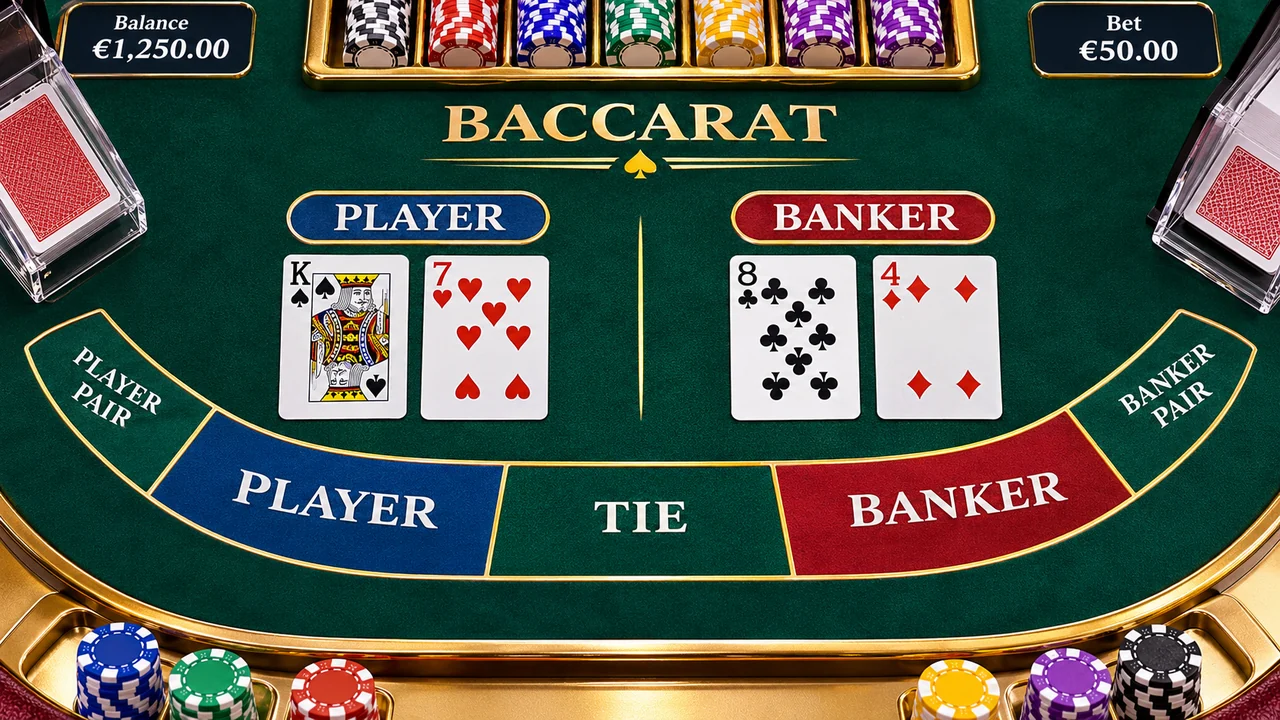
- Choose a chip. Chip values sit along the bottom of the screen. Click one to select it; it stays selected until you change it.
- Place the bet. Click Player, Banker or Tie to drop the chip. Click again to stack. The amount shows inside the betting area.
- Confirm or wait. A software table deals when you press Deal. A live table closes betting on a countdown, so a late click does not land.
- Watch the deal. Two cards to Player, two to Banker, all face up. The totals appear beside each hand — you never add anything.
- The draw, if any. If neither hand is a natural, the third card is resolved automatically, Player first and then Banker.
- Settlement. Winning bets are paid into your balance, commission on a Banker win is handled by the software, and the result is written to the scoreboard.
- Repeat, or not. Your last bet usually stays in place, ready to repeat. That rebet button is the fastest way to stake more than you planned.
The whole cycle takes seconds, and that is the point to hold on to. There is no stage at which skill enters, so the only levers you have are the bet you choose, the stake you choose and the pace of the table you choose.
The drawing rules the software applies for you
You never have to use these tables, which is exactly why most guides leave them out. Read them once and the game stops looking arbitrary: you will know why Banker got a card and Player did not.
The Player hand| Player total on two cards | What happens |
|---|---|
| 0 to 5 | Draws a third card |
| 6 or 7 | Stands |
| 8 or 9 | Natural — the hand ends at once |
Here is the twist that makes Banker the better bet. Banker acts after Player, and what it does depends on Player's third card as well as its own total. If Player stood on six or seven, Banker simply draws on 0 to 5 and stands on 6 or 7. If Player drew, the table below applies.
| Banker total | Draws when Player's third card is | Stands when Player's third card is |
|---|---|---|
| 0 to 2 | always draws | — |
| 3 | 0, 1, 2, 3, 4, 5, 6, 7, 9 | 8 |
| 4 | 2, 3, 4, 5, 6, 7 | 0, 1, 8, 9 |
| 5 | 4, 5, 6, 7 | 0, 1, 2, 3, 8, 9 |
| 6 | 6, 7 | 0, 1, 2, 3, 4, 5, 8, 9 |
| 7 | — | always stands |
One line of information is all it takes: Banker knows Player's third card, and Player never knows Banker's. That is the whole source of Banker's small, permanent advantage, and it is the reason the casino takes a commission on it.
Commission, and what no commission moves
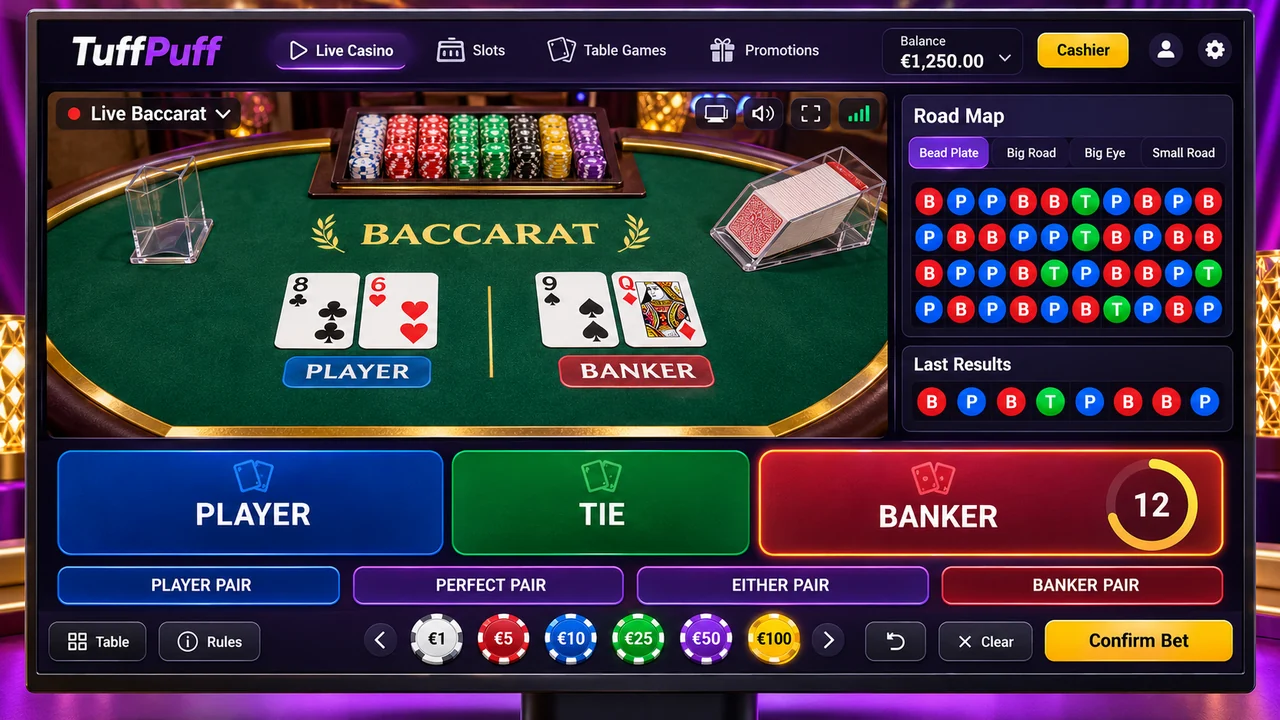
The standard commission on a winning Banker bet is 5%. Bet €100 and win, and the payout is €100 less €5. Most tables record it as you go and settle at the end of the shoe or when you leave, so the figure in your balance can lag the hands you have seen.
The published house edges with that commission are about 1.06% on Banker and about 1.24% on Player, which makes Banker the cheapest main bet at the table even after the 5% is taken. Tie pays 8 to 1 at most tables and 9 to 1 at some, and it is the most expensive bet on the layout at either price — the kind of bet that looks generous and takes a double-digit percentage of everything staked on it.
No commission tables, which is where the search for “squeeze baccarat no commission” usually ends up, pay Banker at even money with one exception: when Banker wins with a total of six, the bet pays half. The commission has not gone anywhere, it has been concentrated into one specific outcome. Settlement is simpler and the cost of play is similar or a touch higher, so read the table information rather than assuming the version you prefer.
A third variant turns up occasionally: a reduced commission with some other condition attached, such as a different limit on side bets. The rule to carry into any of them is that if one number in the table rules has gone down, another has gone up. Where the game sits against the rest of the floor on price is in our comparison of the best casino games by RTP and house edge.
Squeeze, speed and mini: one game at four prices
The rules barely change between baccarat formats. The number of hands per hour changes enormously, and since the house edge is charged on every euro staked, that is the same thing as changing the price.
| Format | What is different | Effect on cost per hour |
|---|---|---|
| Standard live baccarat | Dealer reveals at a normal pace, scoreboard on screen | Baseline |
| Squeeze baccarat | The dealer slowly reveals the cards for drama | Lowest — the slowest format on the floor |
| Speed baccarat | Betting window cut to a few seconds | Highest — far more hands at the same stake |
| Mini baccarat | Smaller table, lower limits, dealer handles all cards | Moderate, with a lower minimum bet |
| RNG software baccarat | You set the pace; no other players | Entirely yours — can be the fastest of all |
| No commission tables | Banker pays even money, 6 pays half | Simpler settlement, similar or slightly higher cost |
Squeeze is the quiet bargain here, and nobody sells it that way. It exists for the theatre of a slow reveal, and the side effect is that you stake less money per hour at the same bet size. Speed baccarat is the opposite deal: identical rules, a stake repeated far more often, and a bill at the end of the hour that is a multiple of the squeeze table's.
RNG tables deserve a specific warning. Because nothing waits for anyone, a player clicking steadily can get through more hands than any live format. The speed is a feature when you are learning and a cost when you are betting.
Side bets and the scoreboard
Around the three main bets sit the extras: Player Pair, Banker Pair, Perfect Pair, Either Pair, and dragon or bonus bets depending on the table. They pay multiples of the stake and they are priced to afford that, which means every one of them costs more per euro than Banker or Player. The payouts are published in the table information, and the honest way to read them is as the price of a rare event rather than as an opportunity.
Then there is the scoreboard — big road, bead plate, and the derived grids beside them. It is the most misread element in the casino. It shows what has happened: runs of Banker, runs of Player, ties, pairs, in a grid that looks like analysis.
It predicts nothing. Hands are independent, so after six Banker wins the seventh hand has exactly the structure the first one had. That also disposes of betting “with the trend“, betting against it, and doubling after a loss: these change the shape of your results, not the house edge, and they empty a budget faster because they raise the average stake.
What the scoreboard is genuinely good for is counting. Glance at the number of hands already dealt and you have a rough measure of the pace of the table, which is the one variable on this page you can actually act on.
What an hour of baccarat costs in euro
Read the house edge as a price per euro staked. At about 1.06% on Banker, each euro staked costs roughly 1c on average; on Player about 1.24c. That is the cheapest main bet in most casinos, and it says nothing about your next hand — it describes an average over far more play than one session contains.
The table below is a worked example. It assumes a €5 bet on Banker and three paces: 40 hands an hour at a squeeze table, 70 at a standard table and 140 at a speed or RNG table. Your pace will differ; what matters is the ratio between the rows.
| Pace | Total staked in an hour | Expected cost at 1.06% | Compared with squeeze |
|---|---|---|---|
| 40 hands (squeeze) | €200 | about €2.10 | baseline |
| 70 hands (standard live) | €350 | about €3.70 | about 1.75 times |
| 140 hands (speed or RNG) | €700 | about €7.40 | about 3.5 times |
| 140 hands on Tie instead, at 8 to 1 | €700 | a double-digit percentage of stakes | many times the Banker cost |
Two things fall out of that table. First, the format you choose moves your hourly cost more than the bet you choose, as long as you stay off Tie. Second, Tie moves it more than everything else combined, which is why it is the one bet worth refusing as a rule rather than a judgement.
Expectation is not a forecast. Short sessions swing wildly either way, and baccarat's near-even main bets swing less than slots but still plenty. What the arithmetic gives you is a sensible answer to the only budgeting question that matters: how long can this balance pay the price before it runs out? For a broader look at where the cheap games are, see our guide to the best payout casinos.
Live tables: the clock, the limits and the seat
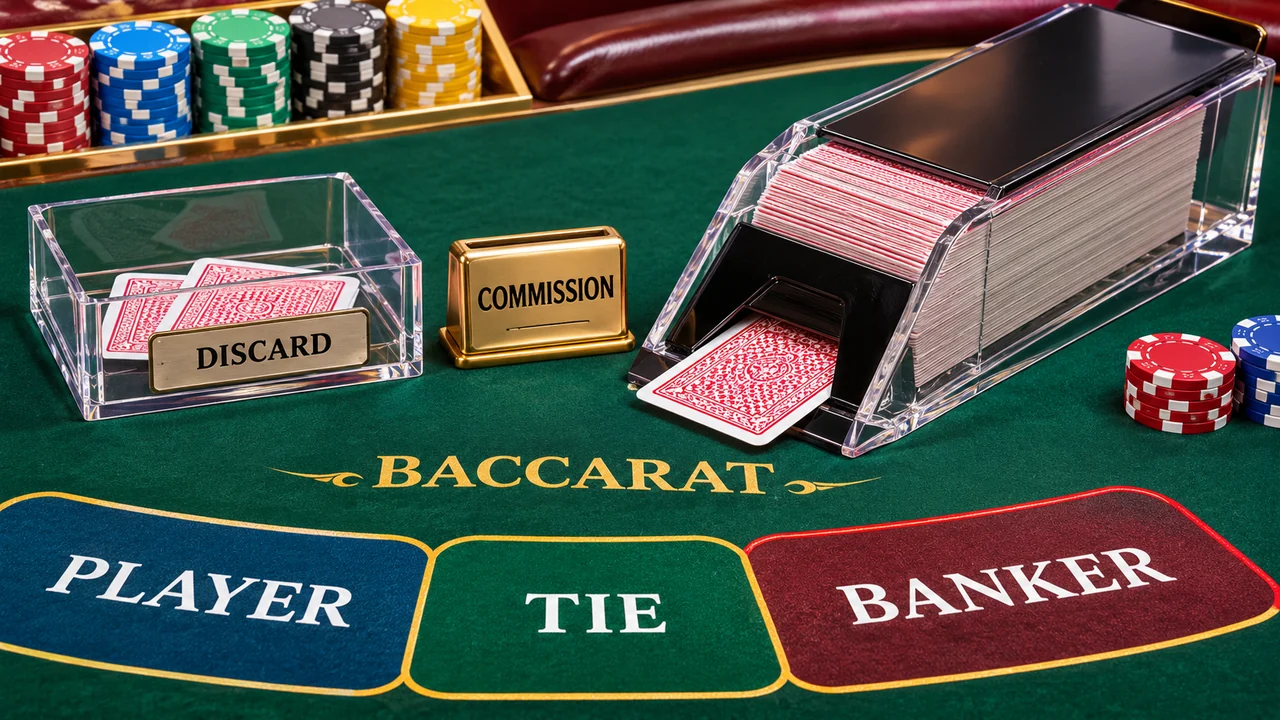
At a live table, betting closes on a countdown, and a missed window means you sit the hand out. There is no decision timer, because there is no decision — which makes baccarat one of the easier games to start in a live room rather than practising elsewhere first.
Limits matter more than studios. The spread between tables within one casino is often wider than the difference between two casinos, and the range is published in the lobby tile and the table information. A €5 minimum and a €25 minimum are the same game with a five-fold difference in what an hour costs at the same pace.
Check the rule variant before you sit, not after: 5% commission or no commission, Tie at 8 to 1 or 9 to 1, which side bets exist and what they pay. Two tables with the same name in the same lobby can differ on all four. How live rooms work generally is covered in our live casino guide, and the rooms themselves are compared in our pick of the best live casino sites.
One last practical note about live baccarat: unlike blackjack, nothing you do affects other players, so a crowded table costs you nothing except a slightly slower pace. In this game a slower pace is a discount.
Practise, then set a limit
Almost every software baccarat game opens in a demo mode with play chips. Ten hands there are enough to learn the layout, see the drawing rules fire and watch the scoreboard fill up. The maths is identical to the real game; only the money is missing, and the controls are where the mis-clicks happen.
Then budget by the shoe rather than by the evening. Decide what you are prepared to stake across a run of hands, divide it by the table minimum to see how many hands that actually is, and you will usually find the answer is smaller than it felt. If the number is under twenty hands, the table is too expensive for the budget, not the other way round.
Set a deposit limit in the account before you fund it, pick the slowest format you find tolerable, bet Banker or Player and leave Tie alone. That is the entire practical content of baccarat strategy, and it is arithmetic rather than advice. Gambling is for over-18s only — stake only money you can afford to lose.
Online baccarat questions
Which baccarat bet is best?
Banker, at a published house edge of about 1.06% even after the 5% commission, against about 1.24% on Player. Tie pays 8 to 1 at most tables and costs a double-digit percentage of everything staked on it, so it is the one bet worth refusing by default.
What does no commission baccarat actually change?
Banker pays even money instead of 95%, except when Banker wins with a total of six, which pays half. The commission is concentrated into that one outcome rather than removed, so settlement is simpler and the cost of play ends up similar or slightly higher.
Is squeeze baccarat worth playing?
If you like the slow reveal, yes, and there is a side effect in your favour: fewer hands per hour at the same stake means less total staked and a lower expected cost. The rules and the odds are the same as at a standard table.
Do I need to learn the third card rules?
No, because you never apply them — the dealer or the software does, always the same way. Reading them once is still worth it, since it explains why Banker draws in some hands and stands in others.
Does the scoreboard help predict the next hand?
No. Hands are independent, so a run of Banker wins does not change the odds on the next one. The grid records the past, and betting with or against a trend changes the shape of your results without touching the house edge.
Can I play baccarat online for free first?
Yes. Most software baccarat games open in a demo mode with play chips, which is enough to learn the layout and the controls. Live dealer tables are real money only, so learn the clicks on a software table first.
Is online gambling for real money legal in Ireland?
Ireland is in the middle of the biggest overhaul of its gambling law in decades. The Gambling Regulation Act 2024 created a single regulator, the Gambling Regulatory Authority of Ireland (GRAI), which was formally established in March 2025. Since 5 February 2026 the GRAI has been the licensing authority for all forms of betting, and its first remote betting licences, covering online and phone betting, apply from 1 July 2026.
Online casino games come later. Applications for the remaining licence types, gaming among them, are due to open throughout 2027 and 2028. In practice, as of October 2026 the GRAI is not yet issuing licences for online casinos. Its public register showed 39 business-to-consumer licence holders in October 2026, and they are betting operators. So when you play at real money casinos in Ireland today, the site is not licensed by the GRAI for casino games, whatever its banners say. If you are looking for an Irish online casino for real money in the licensed sense, there is none yet.
For you as a player, the key detail is that the Act’s duties apply to an operator once it holds a GRAI licence. Those duties include a ban on accepting credit cards, a duty to give you a deposit limit facility and a rule against unreasonably withholding winnings. An offshore casino without a GRAI licence is not bound by these Irish rules in the same way, so your protection rests largely on its own terms and how it behaves. That is why the payout and terms checks in this guide matter so much.
Age is not a grey area. The Act defines a child as anyone under 18, and licensed operators must not let a child gamble. Real money casinos in Ireland, licensed or not, are for adults only, and any site worth using will ask for proof of age before it pays out. If a casino lets you play for weeks without a single question about your age or identity, take that as a warning sign rather than a convenience.
| Rule or milestone | Status |
|---|---|
| GRAI formally established | March 2025 |
| GRAI becomes licensing authority for betting | From 5 February 2026 |
| Remote betting licences (online and phone) | From 1 July 2026 |
| In-person betting licences | From 1 December 2026 |
| Online casino (remote gaming) licences | Applications expected throughout 2027 and 2028 |
| Ban on credit card payments for licensees | In force since 5 February 2026 |
| Deposit limit facility for players of licensees | In force since 5 February 2026 |
| Ban on bonuses and other inducements (s. 157) | Not yet commenced |
| National Gambling Exclusion Register | Not yet commenced |
| TV and radio advertising watershed | Not yet commenced |
Top casinos for real money: why WINSHARK is our pick
For this guide our first choice for playing casino online for real money from Ireland is WINSHARK. It puts a casino, a live casino and a sportsbook on one account with one balance, so you are not juggling logins or moving money between wallets. New players can take a welcome bonus of +250% on your deposit. The brand holds an average score of 5.0 from 2,748 player reviews.

The cashier is the other reason it sits at the top here. WINSHARK lists a wide spread of payment options, with bank cards, e-wallets and cryptocurrencies among them, so most Irish players will find a method they already use. Minimums and limits depend on the method and can change, so confirm them in the cashier after you log in rather than relying on any table on a review site, ours included.
Be clear on one point before you sign up. WINSHARK is an offshore operator and does not hold a licence from the Gambling Regulatory Authority of Ireland (GRAI). Read the full bonus terms on the WINSHARK site before you opt in, set your own deposit limit from the first day and have your ID documents ready so the first withdrawal is not held up.
Your first real money deposit: methods compared
The method you deposit with matters more than the amount, because at most casinos it is also the route your winnings come back on. Pick something you would be happy to receive money to, in euro, in your own name. For most Irish players that means a debit card, Revolut, Apple Pay or Google Pay, a bank transfer, a prepaid paysafecard or crypto.
One rule changed this year. Since 5 February 2026, operators licensed by the GRAI may not accept payment by credit card, and the ban covers e-wallets or other digital routes loaded from a credit card. Whatever the site, treat credit as off limits for gambling. Playing with borrowed money turns a bad night into debt.
Make the first deposit small. It tests the cashier, shows you whether the method works smoothly for your bank and lets you see how the site handles bonuses before more money is at stake. Once it works, you can raise deposits to your planned session amount. Keep the receipts or confirmation emails for the first few payments, so you can match them against the casino’s own history if anything looks off.
| Method | Deposit | Withdrawal | Worth knowing |
|---|---|---|---|
| Visa or Mastercard debit | Usually instant | Often available, usually slower than wallets | Use debit, never credit |
| Apple Pay / Google Pay | Instant, using the card in your phone wallet | Often returned to the underlying card or another method | AIB, Bank of Ireland, PTSB, Revolut and An Post cards work in Apple Pay |
| Revolut | Instant with the Revolut card | To the card or your IE IBAN | Irish branch with IE IBANs; gambling block in the app |
| Bank transfer (SEPA Instant) | Within 10 seconds, 24/7, when both sides support it | To your IBAN | Verification of Payee checks the name on the account |
| paysafecard | Instant with a 16-digit code | Only through a paysafecard account | Up to €50 per transaction without an account |
| Crypto | After network confirmations | To your own wallet address | Price moves and CGT on later gains |
Best online casino games for real money: the numbers compared
There is no single best choice among casino games online for real money, but there are clear differences in price. The table below puts the published figures side by side. Table games with simple bets, such as the Banker bet in baccarat or European roulette, carry some of the lowest house edges in the casino. Slots cost more per euro staked but offer features, free spins and the chance of a large multiplier. Instant games like Plinko sit at the low-edge end, but their speed changes the picture, as the next sections show.
Use the table to rule out bad versions rather than to chase the top line. American roulette and its five-number bet are the clearest examples of games that cost more for no extra entertainment. Blackjack’s price depends on the table rules and how you play, so look for 3 to 2 blackjack payouts and learn basic strategy before you sit down with real money.
Matching the game to the player matters too. If you want long, calm sessions on a small budget, a slot with frequent small wins such as Starburst, with its 23.00% hit frequency, or European roulette on even-money bets fits well. If you want simple low-edge play, baccarat on Banker is hard to beat. If you want features and the chance of a big multiplier, the Pragmatic Play slots above deliver that at around 96.5% RTP, with bigger multipliers and bigger swings.
| Game | Type | RTP or house edge | Source of the figure |
|---|---|---|---|
| Plinko (BGaming) | Instant game | RTP 99% | Provider |
| Baccarat, Banker bet | Table | House edge 1.06% (8 decks) | Game maths |
| Baccarat, Player bet | Table | House edge 1.24% (8 decks) | Game maths |
| European roulette | Table | House edge 2.70% (1/37) | Game maths |
| Big Bass Bonanza | Slot | RTP 96.71% | Pragmatic Play |
| Gates of Olympus | Slot | RTP 96.50% | Pragmatic Play |
| Sweet Bonanza | Slot | RTP 96.48% | Pragmatic Play |
| Fishin’ Frenzy, base version | Slot | RTP 96.12% | Blueprint Gaming |
| Starburst | Slot | RTP 96.08% | NetEnt |
| American roulette | Table | House edge 5.26% (1/19) | Game maths |
| American roulette, 0-00-1-2-3 bet | Table | House edge 7.89% | Game maths |
| Blackjack | Table | Depends on rules and play; 6 to 5 tables cost about 1.39% more than 3 to 2 | Game maths |
Real money bonuses: how wagering works, with a worked example
A casino bonus is money with conditions attached. The main condition is wagering, also called playthrough: you must stake the bonus, sometimes the bonus plus your deposit, a set number of times before any of it becomes withdrawable cash. Until then, the bonus funds and anything won with them belong to the casino’s rules, not to you.

Take a hypothetical offer, not any real casino’s terms: deposit €50, get a 100% match of €50, with 35x wagering on the bonus. You must stake €50 × 35 = €1,750 before you can withdraw. On a slot returning 96%, the expected cost of staking €1,750 is 4% of that, or €70. On average about €30 of the €100 balance is left, €20 less than the €50 you deposited. Make it 35x deposit plus bonus and you must stake €3,500, at an expected cost of €140.
That sum explains why wagering is the first number to read. Lower is better, and anything above about 40x on the bonus is hard work. It also explains the volatility choice: high-volatility slots turn wagering into a bet on one big feature, while low-volatility games grind through it more predictably but rarely leave much on top.
At WINSHARK the welcome bonus is +250% on your deposit. The wagering, eligible games and deadline are set out in the bonus terms on the WINSHARK site, so read them before you opt in. Then run the same sum with the real figures: the bonus amount, times the wagering, times the house edge of the game you plan to play. If the expected cost comes close to the bonus itself, the offer is mainly a way to play longer, not a way to profit.
- 10x on a €50 bonus: €500 to stake, expected cost €20 at 96% RTP.
- 20x on a €50 bonus: €1,000 to stake, expected cost €40.
- 35x on a €50 bonus: €1,750 to stake, expected cost €70.
- 35x on deposit plus bonus (€100): €3,500 to stake, expected cost €140.
- 50x on a €50 bonus: €2,500 to stake, expected cost €100, double the bonus itself.
Cashing out your real money winnings, step by step
A withdrawal is where any real money casino online proves itself. The process is simple when the groundwork is done: account verified, no active bonus, and a payment method in your name that the casino can pay back to. Expect a pending period at many sites while the request is reviewed, followed by the payment time of the method itself. Instant bank transfers and e-wallets tend to be the quickest once approved; cards and standard transfers take longer.
Under the Gambling Regulation Act 2024, a GRAI licensee must not unreasonably withhold the payment of winnings. An offshore casino is held to its own terms instead, which is one more reason to test its withdrawals with a small amount early on. If speed is your priority, our fast withdrawal casino guide compares methods by how quickly money actually lands.
- Check the balance is withdrawableOpen the cashier and look at the split between real money and bonus money. Only the real money part can be withdrawn while a bonus is active.
- Choose the payout methodPick the method you deposited with where possible. The casino may pay up to the deposited amount back to it before using another route.
- Enter the amountRespect the minimum withdrawal for the method. If you won well, consider taking it all and depositing again later rather than leaving a large balance.
- Confirm and answer any checksIf the casino asks for documents or a payment confirmation, send them promptly and in good quality.
- Leave the request aloneDo not reverse it to keep playing. Log out, and note the date and reference of the request.
- Check the money arrived in fullCompare the amount received with the amount requested and query any difference with support in writing.
300 free spins Claim the bonus 18+ · Bonus terms in the WINSHARK rules